5 Desk-Day Habits That Protect Thyroid Energy
Quick Answer: Desk days concentrate the two things that make thyroid-related fatigue worse: long stretches without movement, and a medication and eating schedule that gets displaced by meetings. The five habits below address timing, movement, hydration, light, and the afternoon dip — each one small enough to actually hold on a busy day. None of them replace medical management, and all of them are what people report making the difference around it.
A day at a desk sounds like the easy version. If your energy is already unpredictable, it is often the harder one.

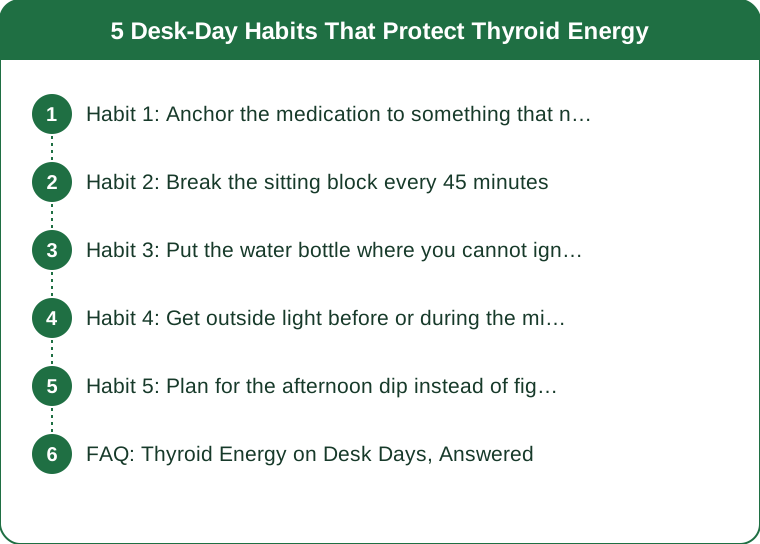
Habit 1: Anchor the medication to something that never moves
Thyroid hormone replacement absorbs best on an empty stomach, and the standard guidance is to take it 30 to 60 minutes before eating, well away from coffee, calcium, iron, and some other supplements. On a desk day, the thing that ruins this is a meeting that pushes breakfast earlier or later.
The fix is to anchor it to an event that cannot move: waking up. Tablet on the bedside table with a glass of water, taken before you get up. That removes the entire scheduling problem in one step, because nothing in your calendar can displace waking.
Then protect the window. Coffee is the most common interference — it can meaningfully reduce absorption, and for a lot of people coffee is the first thing that happens after waking. A 30 to 60 minute gap is the whole requirement, and shifting the tablet to bedside makes that gap happen while you shower and dress rather than needing to be planned.
If mornings are genuinely impossible, bedtime dosing at least three hours after eating is an approach some doctors support — that is a conversation to have with yours, not a change to make unilaterally.
And the desk-specific detail: keep a spare dose at work if your prescription and storage allow it, because the day you forget is a day the whole schedule slides. Consistency of timing matters more than the specific time you choose.
Habit 2: Break the sitting block every 45 minutes
Long uninterrupted sitting produces a specific heavy, foggy fatigue that compounds whatever your baseline energy is. The practical fix is not more exercise — it is interruption.
Set a 45-minute timer for the working day and stand for two minutes on each beep. Walk to fill your water bottle, take the stairs to another floor, or simply stand and look out of a window. The point is a change of position and a small amount of muscle activity, not a workout.
Why 45 minutes rather than 90: it fits inside most meeting blocks and it is short enough that you have not fully settled into the fog before the next break arrives. A break you take before you feel you need it works far better than one taken in response to feeling terrible.
Stack it onto things you already do. Stand for every phone call. Refill water every time you finish a task. Take the long route to the bathroom. Habits attached to existing events survive; habits requiring new decisions do not.
And be realistic about exercise separately. On a low-energy day, a 15-minute walk is a complete and worthwhile session — and for many people with thyroid conditions, gentler, consistent movement is far more sustainable than intense sessions followed by two flat days. Adjust the plan to the day rather than skipping it entirely.
Habit 3: Put the water bottle where you cannot ignore it
Mild dehydration produces headache, poor concentration, and a heavy, tired feeling — which is easy to attribute to your thyroid and is often just water. Desk days are where it happens most, because there is no natural prompt to drink.
The change that works is location, not intention. A large bottle on the desk, within your visual field, refilled at a fixed point — after each break, or on a schedule. A bottle in a bag is a bottle you will not drink.
Aim for something specific and countable. Finishing a one-litre bottle by lunch and another by the end of the day is a target you can actually check, unlike drinking more water.
Two thyroid-specific notes. Take the morning medication with plain water, not coffee or a drink containing calcium, as above. And if you use a supplement in your water, check whether it contains calcium, magnesium, or iron — all of which interfere with absorption and should be kept several hours from your dose.
And watch the coffee count. Caffeine is not off-limits and a large amount on a fatigued day tends to produce a sharper crash later, plus it costs sleep if it runs late. Two cups before midday is a reasonable working pattern for most people, and the last one earlier than feels natural.

Habit 4: Get outside light before or during the middle of the day
Bright light exposure has a direct alerting effect and it helps set the circadian signal that governs when you feel awake and when you sleep. On a desk day you can easily go from a dark morning commute to a dark evening one without meaningful daylight, and that flattens energy across the whole day.
Ten minutes outside at lunch is the intervention. Not a walk you have to plan — stepping outside the building and standing there counts. Even an overcast day delivers far more light than an office interior, by a very large margin.
Why it matters more with a thyroid condition: fatigue and disrupted sleep frequently travel together, and poor sleep makes the next day worse. Daylight is one of the few free, reliable inputs into the sleep side of that loop.
Combine it with habit 2 and you have one action doing two jobs — a mid-day break that is also a light exposure.
And this gets more important over the next few months, not less. As autumn progresses, daylight shortens at both ends and lunchtime becomes the only genuinely bright part of many people’s day. The habit that felt optional in July is the one holding the schedule together in November. If you find your energy and mood dropping consistently with the season, that is worth mentioning to your doctor rather than absorbing.
Habit 5: Plan for the afternoon dip instead of fighting it
Most people have a genuine early-afternoon energy trough, and with a thyroid condition it often lands harder. The habit is not to power through it — it is to schedule around it.
Put the low-demand work there. Email, admin, filing, routine tasks. Save the work that needs real cognitive effort for your best hours, which for most people are the first three of the working day.
Eat lunch in a way that does not add to it. A moderate meal with protein and fibre rather than a large carbohydrate-heavy one — the goal is to remove food as a contributing factor, not to find an energising combination.
Take the break before the dip, not after. A ten-minute walk at 1pm works considerably better than a coffee at 2:30, because it acts before the fog sets in.
And track the pattern for two weeks. Note your energy at three points a day, plus sleep and any symptoms. Two weeks of simple notes is genuinely useful information for a doctor’s appointment — far more so than trying to describe it from memory, and it often reveals a pattern you had not seen.
One important boundary on all five of these habits: they are the daily practicalities around treatment, not a substitute for it. Persistent fatigue, changes in weight, hair, mood, temperature tolerance, or heart rate are things to take to your doctor — including the possibility that a dose needs reviewing, since requirements change over time. If you feel consistently unwell despite normal labs, that is a conversation worth having rather than tolerating. This is general information, not medical advice.
FAQ: Thyroid Energy on Desk Days, Answered
How long do I really need to wait after my thyroid medication before eating?
The usual guidance is 30 to 60 minutes on an empty stomach, and consistency matters as much as the exact gap — taking it the same way every day gives you and your doctor a stable baseline to judge your dose against. Coffee, calcium, and iron are the main things to keep away from it, with iron and calcium supplements ideally separated by several hours.
Is it better to exercise in the morning or after work with thyroid fatigue?
Whichever one you will actually do consistently, which for most people with unpredictable energy is the morning, before the day erodes the plan. What tends not to work is a schedule that requires you to feel good — a plan with a short, easy default option for low-energy days survives far better than one built around your best days.
My labs are normal but I still feel exhausted at my desk all day. What now?
That is a common and legitimate thing to raise with your doctor rather than accept, and it is worth going in with two weeks of written notes on energy, sleep, and symptoms. Normal labs narrow the possibilities without closing the question, and there are other causes of persistent fatigue worth ruling out. In the meantime, the habits above are the ones people most often report helping around the edges.
TL;DR:
- Anchor your medication to waking rather than to breakfast, and keep coffee, calcium, and iron out of the window
- Break the sitting block every 45 minutes with two minutes of standing or walking, attached to things you already do
- Keep a large water bottle in your visual field with a countable target, and take the morning dose with plain water
- Get ten minutes of outside light in the middle of the day — it matters more as the season darkens
- Schedule low-demand work into the afternoon dip, take the break before it, and keep two weeks of notes for your doctor
Five small structural changes, none of which require energy you do not have. They are the practical scaffolding around proper medical management, not a replacement for it — and persistent fatigue is always worth taking back to your doctor.
Keep Reading
This article is for general informational purposes only and is not medical advice. Always consult a qualified health professional for guidance specific to you.