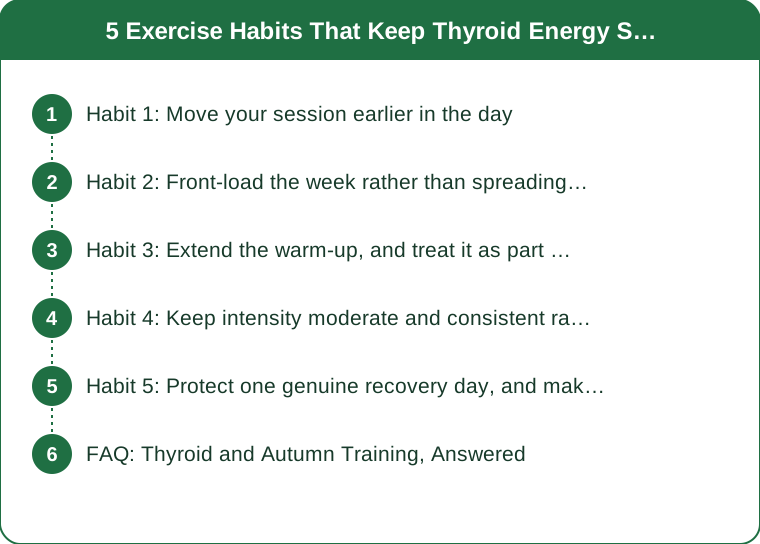
5 Exercise Habits That Keep Thyroid Energy Steady in Autumn
Quick Answer: Autumn is a predictable pressure point for thyroid energy: less daylight, colder mornings, and a return to a fuller schedule. Five habits hold energy steady through it: training earlier in the day, front-loading the week, warming up longer, keeping intensity moderate and consistent, and protecting the recovery day. None of them require doing more.
Each one below is a specific change with a reason attached.

Habit 1: Move your session earlier in the day
Thyroid-related fatigue tends to worsen through the day, and it worsens faster as daylight shrinks. A session that felt manageable at 6pm in July is a different proposition at 6pm in October, when it’s already dark and you’ve been running on a longer fatigue curve.
The practical change is moving training to the first half of the day, ideally morning or lunchtime. Morning light exposure is a second benefit here, since it supports circadian rhythm at exactly the season when it’s under pressure, and circadian disruption makes hypothyroid fatigue harder to manage.
If mornings genuinely don’t work, lunchtime is a strong second choice and still gets you daylight. The change most people report is not that the session feels easier, but that the rest of the day holds up better afterward. This is general information, not medical advice.
Habit 2: Front-load the week rather than spreading it evenly
Three sessions spread as Monday, Wednesday, Friday looks balanced on paper. For many people managing thyroid fatigue, it isn’t, because energy is rarely even across the week.
Most people have more capacity early in the week and less by Thursday and Friday, and autumn amplifies that pattern as the accumulated fatigue of shorter days builds. Placing the two most demanding sessions on Monday and Tuesday and leaving the end of the week for something gentle means the hard work happens when the capacity exists.
The alternative, and the one people default to, is planning evenly and then skipping Friday most weeks. That’s the same total training with the added cost of feeling like you failed at it. Planning around the real energy curve produces better consistency and a much better relationship with the plan.
Habit 3: Extend the warm-up, and treat it as part of the session
Cold intolerance is one of the most common features of hypothyroidism, and it isn’t only about how you feel. Muscle and connective tissue are genuinely less compliant when cold, and if you run cooler than average to begin with, an autumn morning start is a bigger gap to close.
A warm-up that worked in August, five minutes of easy movement, is often insufficient in October. Ten to twelve minutes, starting very easy and building gradually, changes how the whole session feels.
What that looks like in practice: a few minutes of walking or easy cycling, then joint mobility through the ranges you’re about to use, then two or three progressively heavier or faster build-up sets before the working sets begin. The session doesn’t need to get longer overall; the warm-up borrows time from the working part, and the working part usually goes better for it.

Habit 4: Keep intensity moderate and consistent rather than variable
The temptation, when energy is unpredictable, is to train hard on good days and skip bad ones. It’s understandable and it produces a worse outcome than a steady moderate approach.
High-intensity sessions on a good day tend to borrow from the following days, which turns one good day into two poor ones. Over a month, that pattern produces less total training and more fatigue than a consistent moderate approach at the same weekly volume.
A usable guideline is to work at a level where you could hold a conversation in short sentences, and to stop each session feeling like you could have done a little more. For strength work, that means leaving two or three reps in reserve rather than training to failure.
This is the habit that most changes how autumn feels, and it’s the least intuitive, because it means deliberately doing less on the days you feel most able to do more.
Habit 5: Protect one genuine recovery day, and make it a moving one
Rest days for thyroid fatigue work better when they include movement rather than when they’re entirely still. Complete rest often leaves people stiffer and more tired, while a walk, gentle mobility work, or easy swimming maintains the energy benefit without adding load.
The distinction that matters is intent. A recovery day is not a light training day, and the common failure is turning it into one because it feels productive. Twenty to forty minutes of easy walking is the whole prescription.
And one autumn-specific point: schedule that walk in daylight if at all possible. As the days shorten, the recovery day is often the only one with the flexibility to get outside in the light, and the combination of easy movement plus daylight exposure does more for the following week’s energy than the walk alone.
If fatigue is worsening despite steady habits, or if new symptoms appear, that’s a reason to review medication and labs with your doctor rather than to adjust training further. Exercise adjustments manage the symptom; they don’t treat the condition. This is general information, not medical advice.
FAQ: Thyroid and Autumn Training, Answered
Should I train at all when fatigue is bad?
Often yes, at a reduced level. Light activity generally improves rather than worsens thyroid-related fatigue, and complete inactivity tends to deepen it. The judgement call is intensity, not whether.
Does exercise affect my thyroid medication?
Not directly, though absorption timing matters and is affected by food and some supplements including calcium and iron. Taking medication on an empty stomach and leaving a gap before food, coffee, or supplements is the standard advice, and your doctor or pharmacist is the right source for your specific case.
Why is my heart rate higher for the same effort in autumn?
Several possible reasons, including detraining, temperature, and sleep quality. If it’s persistent and marked, or comes with palpitations, breathlessness, or unusual fatigue, it’s worth mentioning to your doctor rather than training through it.
TL;DR:
- Train earlier in the day, when thyroid fatigue is lower and daylight is available.
- Front-load the week rather than spreading sessions evenly, so hard work lands where the capacity is.
- Warm up for ten to twelve minutes rather than five, because cold intolerance is a real mechanical factor.
- Keep intensity moderate and consistent instead of alternating hard days and skipped days.
- Protect one recovery day and spend part of it walking outside in daylight.
None of these five involve doing more. They involve putting the same work where your energy actually is, which is what autumn changes. Worsening fatigue or new symptoms belong with your doctor rather than in a training adjustment. This is general information, not medical advice.
Keep Reading
This article is for general informational purposes only and is not medical advice. Always consult a qualified health professional for guidance specific to you.