5 Layering Habits That Make Thyroid Cold Intolerance Manageable
Quick Answer: Cold intolerance associated with thyroid conditions is not fixed by wearing more — it is fixed by wearing the right things in the right order, protecting the extremities first, and managing the temperature swings between indoors and out. Five habits cover almost all of it, and none of them require buying a new wardrobe.
Everyone else takes their coat off and you keep yours on.
Your hands are cold in a warm room.
This is one of the most common symptoms and one nobody plans around.

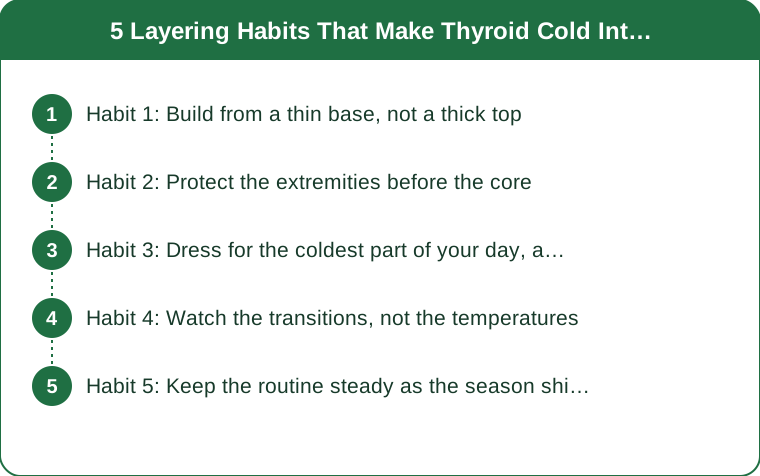
Habit 1: Build from a thin base, not a thick top
The layer against your skin does more than the layer on top of it.
A thin base layer worn close to the skin traps a stable layer of warm air, and that trapped air is what actually insulates. A single thick jumper over a cotton t-shirt insulates less well than a thin merino base under a medium knit, because the base is doing a job the outer layer cannot.
Fibre matters more here than anywhere else in the outfit. Cotton holds moisture against the skin and cools you as it evaporates, which is the opposite of what you want. Merino wool and synthetic base layers move moisture away and keep insulating when slightly damp.
This is also the layer that solves the indoor-outdoor swing. You can remove a jumper in a warm office and keep the base, which means you stay comfortable across a temperature range rather than at one point in it.
Practically: a thin long-sleeve base under everything, from about now until spring. It is invisible, it costs almost nothing in bulk, and it is the single highest-return change in the whole list.
Cold intolerance can be a symptom of several things. This is general information, not medical advice — persistent or new cold intolerance is worth discussing with a professional.
Habit 2: Protect the extremities before the core
Cold hands and feet are usually where this is felt first, and they are usually the last thing addressed.
The body reduces blood flow to the extremities to preserve core temperature, which means hands and feet get cold before anything else and stay cold longest. Adding a scarf and a coat while wearing thin socks solves the wrong end of the problem.
Feet are the highest-return target. Wool socks rather than cotton, and a shoe with enough room that the sock is not compressed — a tight shoe restricts circulation and makes a good sock useless. This is a common and entirely avoidable mistake.
Hands need a layer indoors as well as out. Fingerless gloves or wrist warmers at a desk are not excessive, and they make a measurable difference to how the whole day feels.
And the neck is worth more than its size suggests. A significant amount of blood flows close to the surface at the neck, so covering it retains heat efficiently. A light scarf indoors is a genuinely effective and socially invisible tool.
Practically: wool socks, roomy shoes, something for the wrists, and a light scarf that stays on indoors.

Habit 3: Dress for the coldest part of your day, and shed
Most people dress for the temperature when they leave the house, which is rarely the temperature they will be coldest in.
The coldest points in a typical day are the early morning, the walk between places, and any long stationary period — waiting, sitting still, or being in a room that has not been heated. None of these are the moment you get dressed.
Layering solves this in a way a single warm garment cannot. Three thin layers offer four states — all on, two, one, none — while one thick coat offers two. For someone whose comfortable range is narrow, more states is the entire point.
Stationary is much colder than moving. Sitting still generates a fraction of the heat that walking does, which is why a coat that is fine on the walk is inadequate on the bench at the end of it. Plan for the sitting, not the walking.
Keep a spare layer where you spend time. A cardigan at your desk, a wrap in the car, a jumper in your bag — the layer you can add is worth more than the layer you are already wearing.
Practically: dress for the coldest twenty minutes of the day and remove layers for the rest of it.
Habit 4: Watch the transitions, not the temperatures
The uncomfortable moments are almost always changes rather than states.
Going from a heated building into cold air, or arriving somewhere warm while still wearing everything, are where discomfort concentrates. The body takes time to adjust, and cold intolerance often means that adjustment takes longer.
Getting slightly damp is what turns cold into miserable. Sweating inside a coat on a warm train and then stepping outside means evaporative cooling on top of cold air, which is far worse than either alone. Take the coat off on the train.
Morning is the hardest transition of the day. Core temperature is at its daily minimum in the early morning, so getting up and getting dressed in a cool house is genuinely the coldest you will be. Warming the room or the clothes first is not indulgent — a few minutes of heating in the bedroom, or clothes kept somewhere warm, changes the whole start of the day.
And a hot drink genuinely helps at transitions. The warming effect is modest and the timing is what matters — before going out, not after coming in.
Practically: remove layers before you get warm, add them before you get cold, and plan the morning specifically.
Habit 5: Keep the routine steady as the season shifts
Cold intolerance is easier to manage when the rest of the routine is not also being disrupted.
Medication timing is the one to protect. Thyroid medication absorption is affected by timing relative to food, coffee, and certain supplements, and autumn schedule changes — new term, darker mornings, different wake times — are exactly what disrupts an established routine. Keep the medication anchored to waking rather than to the clock.
Eating regularly matters more in cold weather. Thermoregulation uses energy, and skipping meals on a cold day makes the cold feel considerably worse. This is one of the more noticeable everyday effects.
Movement is the fastest way to warm up and the easiest to lose in autumn. A short walk generates more heat than any garment provides, and outdoor movement drops sharply as the evenings darken. Building in a deliberate midday walk protects both warmth and daylight exposure.
Track what actually helps. Symptoms vary and the useful adjustments are individual, so noting which days were manageable and what was different is more valuable than any general advice — including this list.
And keep your reviews on schedule. Symptoms that change with the season are worth mentioning at a routine review, and autumn is when many people notice a shift. This is general information, not medical advice — a change in symptoms is a conversation to have with a professional rather than a wardrobe problem to solve alone.
Practically: protect the medication routine, eat regularly, keep a daily walk, and raise seasonal changes at your next review.
TL;DR:
- Build from a thin moisture-moving base layer — it does more than a thick outer one.
- Protect hands, feet and neck first; the body sacrifices extremities to protect the core.
- Roomy shoes matter as much as wool socks — a compressed sock does nothing.
- Dress for the coldest twenty minutes of your day, then shed layers.
- Manage transitions, not temperatures: remove layers before you get warm.
- Keep medication timing anchored to waking as autumn schedules shift.
- A short daily walk generates more heat than any garment and is the easiest thing to lose.
Cold intolerance is not solved by more clothes. It is solved by better order.
Keep Reading
This article is for general informational purposes only and is not medical advice. Always consult a qualified health professional for guidance specific to you.