5 Evening Habits That Protect Thyroid Energy as Daylight Shrinks
Quick Answer: Shrinking daylight disrupts sleep timing, and disrupted sleep amplifies thyroid-related fatigue more than almost anything else. Five evening habits — a consistent wind-down, controlled light exposure, a protein-containing evening meal, warmth management, and protecting the medication window — address the specific ways autumn makes thyroid symptoms harder to manage.
Mornings get all the attention in thyroid routines because that is when medication is taken. The evening is where autumn actually does its damage, and these five changes are the ones worth making before the clocks go back.

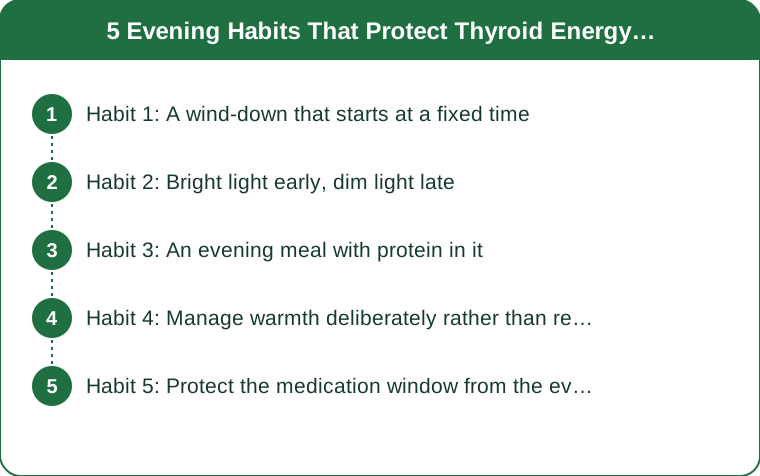
Habit 1: A wind-down that starts at a fixed time
The most important of the five, and the one most disrupted by autumn.
As evenings get darker earlier, the natural cues that structure the end of the day disappear. Without daylight marking the transition, evenings stretch and bedtimes drift later — often by an hour or more between September and November without anyone deciding to change anything.
Fatigue associated with an underactive thyroid is significantly amplified by irregular sleep timing. Consistency of bed and wake times matters more for sleep quality than total hours, and thyroid-related tiredness is particularly sensitive to poor-quality sleep rather than simply insufficient sleep.
The practical version: pick a fixed time to begin winding down — not to be asleep, but to start — and hold it regardless of how dark it got at 4pm. Thirty to sixty minutes before your target bedtime, with the same sequence each night. The sequence matters as much as the timing, because a repeated pattern becomes its own cue once daylight stops providing one.
Habit 2: Bright light early, dim light late
Light exposure is the strongest signal your body clock receives, and autumn reduces it dramatically at exactly the wrong times.
Most people in autumn get too little bright light in the morning and too much artificial light in the evening — the inverse of what supports good sleep timing. Morning light exposure anchors the circadian rhythm; evening light delays it.
For anyone managing thyroid-related fatigue, this matters twice over: the sleep disruption worsens the fatigue directly, and the resulting late-morning grogginess frequently gets attributed to the thyroid condition when it’s a circadian issue sitting on top of it.
The evening half of the fix is straightforward. Lower the overall light level in the last hour — lamps rather than overhead lighting, and screens dimmed or set to a warmer color temperature. It’s a modest intervention with a well-supported mechanism.
The morning half matters as much: fifteen minutes of outdoor light early, even on an overcast day, delivers far more illuminance than any indoor lighting and is one of the more practical things you can do for autumn energy.

Habit 3: An evening meal with protein in it
Evening eating patterns shift in autumn — meals get heavier, later and more carbohydrate-dominant as the weather turns, and that combination affects sleep quality.
Protein at the evening meal supports more stable overnight blood glucose, which reduces the early-waking and restless-sleep pattern that many people notice when their evening meals become carbohydrate-heavy. It also supports satiety, which matters because autumn appetite changes are common and often lead to late snacking.
There’s a specific thyroid consideration too: adequate overall protein intake matters for anyone managing an underactive thyroid, and evening is the meal most often short on it when routines get busy.
Practical version: include a palm-sized portion of a protein source at the evening meal, and don’t let the meal drift much later than usual as the evenings get darker. A meal finishing two to three hours before bed is the commonly recommended pattern, and it’s harder to hold in autumn than in summer.
One caveat worth knowing: certain minerals — calcium and iron in particular — interfere with thyroid medication absorption, which is a reason to keep supplements away from the medication window rather than a reason to avoid them at dinner.
Habit 4: Manage warmth deliberately rather than reactively
Cold intolerance is one of the most commonly reported symptoms of an underactive thyroid, and the first cold evenings of autumn tend to arrive before the heating does.
Being cold in the evening affects sleep onset directly. Falling asleep requires core body temperature to drop, and that drop happens through the extremities — so cold hands and feet actually impede sleep onset rather than helping it. Warming the extremities before bed, counterintuitively, helps you fall asleep faster.
The practical measures are simple and worth doing deliberately rather than in response to already being cold:
Warm the extremities specifically. Socks in bed, a warm foot bath, or a hot water bottle at the feet. This is more effective for sleep onset than heating the room.
Layer the evening rather than heating the whole house. A warm layer put on at the same time each evening becomes part of the wind-down cue as well as a comfort measure.
Keep the bedroom cooler than the living room. The temperature drop between rooms reinforces the transition. A cool bedroom with warm feet is the combination that supports sleep best.
Habit 5: Protect the medication window from the evening backward
Thyroid medication timing is a morning issue that gets decided the night before.
Levothyroxine absorption is affected by food, coffee, calcium and iron, which is why the standard guidance is to take it on an empty stomach, typically 30 to 60 minutes before breakfast. The most common reason people miss that window is a disrupted morning, and disrupted mornings in autumn are usually the product of a drifting bedtime.
Some people take their medication at bedtime instead, which is a recognized alternative — it requires a gap of several hours after eating and should only be changed in discussion with the prescriber, since it affects how test results should be interpreted.
The evening actions that protect the morning window:
Set out what you need the night before, so the routine survives a groggy morning. Decide your bedtime backward from the time you need to get up with enough margin for the medication gap. And if you take it at night, put it somewhere that makes the timing gap after dinner obvious rather than something you have to calculate.
FAQ: Evening Routines and Thyroid Energy
Does the time change make symptoms worse?
Many people report a difficult fortnight around the clock change, consistent with circadian disruption. Shifting bedtime by 15 minutes across several days beforehand reduces the impact.
Should I change my medication dose in winter?
Never adjust dosing on your own. Some people do require seasonal adjustment and that is a decision made with a clinician based on blood tests. This is general information, not medical advice — talk to your doctor about any symptom change.
TL;DR:
- Fix the wind-down start time before darkness erodes your bedtime by an hour.
- Bright light in the morning, dim light in the last hour — autumn inverts both by default.
- Include protein at the evening meal and keep the meal from drifting later.
- Warm your feet to fall asleep faster, and keep the bedroom cooler than the living room.
- Protect the morning medication window by deciding bedtime backward from it.
Mornings get the attention because that is when the medication is taken. The evening is where autumn actually takes the energy, and these five habits are what hold the line.
Keep Reading
This article is for general informational purposes only and is not medical advice. Always consult a qualified health professional for guidance specific to you.