Five Everyday Signs Your Thyroid Symptoms Shift With the Season
Quick Answer: Thyroid hormone requirements can shift modestly with the seasons for some people, and colder months are when hypothyroid symptoms most commonly become noticeable again. That does not mean adjusting anything yourself - dose changes are a clinical decision based on blood tests, not on how you feel. What is useful is noticing where the change shows up in ordinary life, so you can describe it accurately when you next speak to your doctor. Five common situations, and what each one is worth reporting.
This is about noticing precisely, not about self-adjusting. This is general information, not medical advice.

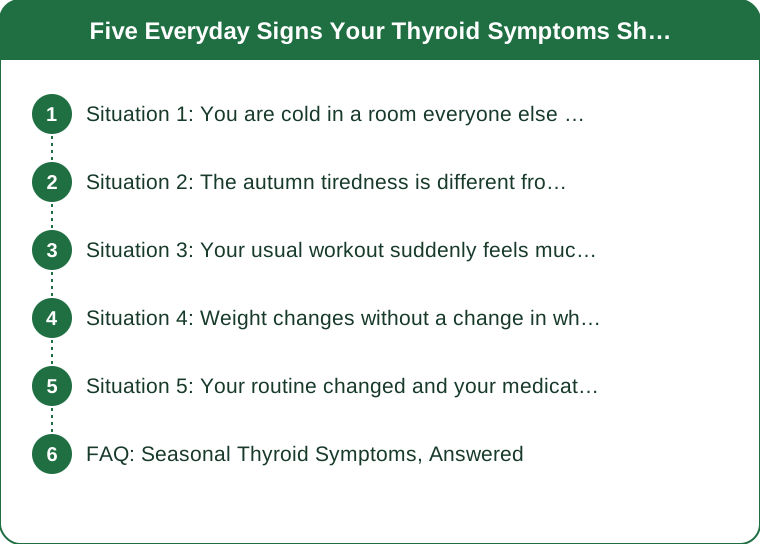
Situation 1: You are cold in a room everyone else finds comfortable
Cold intolerance is one of the more recognisable features of an underactive thyroid, and it becomes obvious in autumn when everyone’s environment cools at once.
The useful detail is the comparison - being cold relative to the people around you in the same room is more informative than simply feeling cold in October.
Notice whether it is new, or a return of something familiar, since a returning symptom in someone already treated is a different conversation from a new one.
Cold hands and feet specifically are common and have many possible causes, so they are worth mentioning rather than interpreting.
Keep it concrete when you report it: which rooms, how it compares to last winter, whether extra layers resolve it.
And note that a cold house in autumn is a perfectly ordinary explanation too - the point is to describe rather than to diagnose.
Situation 2: The autumn tiredness is different from ordinary autumn tiredness
Almost everyone is more tired as daylight shortens, which makes this the hardest symptom to interpret.
The distinguishing question is whether sleep helps. Ordinary seasonal tiredness generally improves with a good night; thyroid-related fatigue often does not.
Look at whether it is affecting function - work, exercise capacity, concentration - rather than only how you feel.
Note the pattern across a week, since a consistent flat fatigue reads differently from one tied to particular days.
Low mood in autumn has its own well-recognised seasonal pattern, and it overlaps with thyroid symptoms considerably, which is exactly why a blood test rather than a self-assessment is what settles it.
Iron deficiency, vitamin D deficiency and sleep problems all produce similar autumn fatigue, and all are checkable.
Situation 3: Your usual workout suddenly feels much harder
Exercise capacity is a sensitive everyday measure and often changes before anything else is obvious.
The useful comparison is a known session - the same class, route, or weight you have done for months.
Note recovery as well as performance, since slower recovery between sessions is a common report.
Muscle aches and stiffness that do not match the training are worth mentioning specifically.
Heart rate that runs unusually low or unusually high for your normal effort is another concrete data point.
And do not stop training on this basis alone - reduce intensity if you need to, keep the habit, and get it checked. This is general information, not medical advice.

Situation 4: Weight changes without a change in what you are doing
Modest weight change is a commonly reported thyroid symptom and is also one of the most misattributed.
Autumn brings genuine behavioural changes - less daylight activity, more indoor eating, different food - which explain a great deal of autumn weight change on their own.
The informative version is a change with no corresponding behaviour change, tracked over several weeks rather than days.
Fluid retention and puffiness, particularly around the face, are a separate and more specific observation than weight alone.
Bring numbers rather than impressions to an appointment if you have them.
And avoid making large dietary changes to compensate before you know what is happening, since that removes the very signal you are trying to describe.
Situation 5: Your routine changed and your medication timing moved with it
Levothyroxine absorption is sensitive to timing and to what else is in your stomach, which makes routine changes genuinely relevant.
It is usually advised on an empty stomach, well before food, and coffee in particular can reduce absorption.
Calcium and iron supplements interfere substantially and are generally kept several hours apart.
Autumn routine changes - school terms, darker mornings, shifted work patterns - move medication timing without anyone deciding to.
Consistency matters more than any specific time, so if your morning has changed, that is worth mentioning.
Never adjust your own dose based on symptoms or the season. Dose changes follow blood tests and a clinician’s judgement, and self-adjusting is genuinely risky. This is general information, not medical advice.
FAQ: Seasonal Thyroid Symptoms, Answered
Do thyroid symptoms really change with the season?
Symptoms commonly become more noticeable in colder months, and some people’s requirements shift modestly. Any dose decision belongs to your clinician.
Should I ask for a blood test in autumn?
If symptoms have changed noticeably, it is a reasonable thing to raise. Your doctor will decide on timing and testing.
Can I adjust my own dose in winter?
No. Dose changes are based on blood tests and clinical judgement, and self-adjusting is risky.
Why does coffee matter with levothyroxine?
It can reduce absorption. Standard advice is an empty stomach well before food and drink, with calcium and iron kept hours apart.
Is autumn tiredness thyroid or just the season?
Often the season, and they overlap. Whether sleep helps is a useful distinguishing question, but only a test settles it.
What should I bring to the appointment?
Concrete comparisons - a known workout, room-temperature comparisons, weight over weeks, and any change in medication timing. This is general information, not medical advice.
TL;DR:
- Hypothyroid symptoms commonly become more noticeable in colder months, and some people’s requirements shift modestly.
- Cold relative to others in the same room is more informative than simply feeling cold in autumn.
- Whether sleep helps is the most useful question separating ordinary seasonal fatigue from something else.
- Autumn routine changes quietly move medication timing, and levothyroxine absorption is timing-sensitive.
- Never self-adjust a dose - describe changes concretely and let blood tests and your clinician decide.
Notice precisely, report clearly, and leave the dose to your doctor. This is general information, not medical advice.
Keep Reading
This article is for general informational purposes only and is not medical advice. Always consult a qualified health professional for guidance specific to you.