5 Travel Day Habits That Keep Thyroid Medication on Schedule
Quick Answer: Thyroid medication is absorbed best on an empty stomach with a consistent gap before food, coffee, and other supplements. Travel breaks that pattern through time zone shifts, early airport meals, and packed-away luggage. Keep the medication in your carry-on, keep it on home time until you arrive, and protect the gap before breakfast. Consistency matters more than the exact clock time.
The medication is not fragile.
The routine around it is - and that is the part travel breaks.

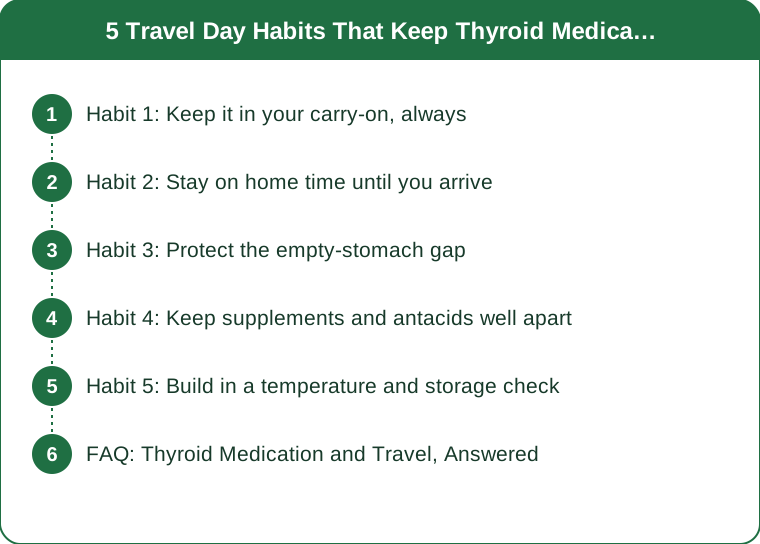
Habit 1: Keep it in your carry-on, always
Medication in checked luggage is medication you may not have. Delayed or lost bags are common enough that this is a real risk rather than a theoretical one, and thyroid medication is not something you want to skip for several days.
Keep it in the bag that stays with you, in its original labelled packaging, along with a copy of the prescription. Original packaging matters at borders and makes any pharmacy conversation abroad far simpler.
Pack more than the trip requires. A few extra days’ worth covers delays, extensions, and the tablet that ends up on a hotel floor. The extra weight is nothing and the protection is significant.
And split the supply if you are travelling with someone. Half in your bag, half in theirs, is a simple hedge against losing one bag entirely.
Habit 2: Stay on home time until you arrive
Trying to shift the dose mid-journey creates gaps and doubles. The simplest approach for a short trip is to keep taking it at your usual home time, converted to local time, for the whole trip.
For longer trips, shift gradually after you arrive. Moving the dose time by an hour or so a day until it lines up with your new morning keeps the interval between doses roughly consistent. Large sudden shifts are what cause problems, not the change itself.
Set an alarm labelled clearly on your phone. Phones update to local time automatically, which is helpful once you have decided which time you are working to - and confusing if you have not.
And if you are unsure how to handle a big time difference, ask your pharmacist before you go. It is a two-minute conversation, they answer it regularly, and it is far better than improvising at an airport. This is general information, not medical advice.
Habit 3: Protect the empty-stomach gap
The gap before food is the part travel destroys. Airport mornings involve early coffee and whatever food is available, and thyroid medication absorbs considerably less well when taken close to a meal.
Take it as soon as you wake, before anything else. Water only, then wait the interval you normally use before eating or drinking coffee. Coffee in particular reduces absorption meaningfully and is the most common travel-day mistake.
Plan the wait around the journey. If your flight boards at the time you would normally eat, take the tablet earlier so the gap finishes before the food arrives rather than during it.
Carry a bottle of water for the dose itself. Airport security means no liquids through the checkpoint - buy water immediately after, or take the dose before you leave for the airport.

Habit 4: Keep supplements and antacids well apart
Calcium, iron, and magnesium all interfere with absorption, and travel is exactly when people take extra supplements - iron for tiredness, magnesium for sleep, antacids for unfamiliar food.
Separate them by several hours. Thyroid medication in the morning, minerals in the evening, is the arrangement that handles this automatically without requiring you to remember anything.
Watch for hidden sources. Fortified breakfast foods, some antacids, and multivitamins all contain minerals that interact. A hotel breakfast is a more likely interaction than a supplement bottle.
And keep the evening supplements in a separate container from the morning ones. Two clearly different containers removes the decision entirely when you are tired and in an unfamiliar room.
Habit 5: Build in a temperature and storage check
Heat and humidity affect medication. A tablet left in a hot car, on a sunny windowsill, or in a bathroom for a fortnight is not in ideal storage conditions.
Keep it in the main cabin, not the hold. Cargo holds vary in temperature considerably, which is another argument for carry-on beyond the lost-luggage one.
In a hotel, store it in the room rather than the bathroom. Bathrooms are the most humid room in any building. A bedside drawer is a better choice than the place everyone defaults to.
And check the expiry before you pack. A trip is a bad time to discover a pack ran out last month. A thirty-second check while packing is the whole habit.
FAQ: Thyroid Medication and Travel, Answered
What if I miss a dose entirely?
Ask your pharmacist or doctor what they advise for your specific medication and dose - the general guidance varies. Do not double up on your own initiative without checking; one missed dose is usually less consequential than an improvised correction.
Does flying itself affect thyroid medication?
No. Cabin pressure and altitude do not affect the medication. The disruption is entirely about timing, food, and storage - all of which are manageable with planning.
Should I get my levels checked after a long trip?
Not routinely for a normal holiday. If you have had an extended trip across several time zones with an inconsistent routine, and you feel different afterwards, that is worth mentioning at your next appointment rather than ignoring.
TL;DR:
- Carry-on only, in original packaging, with several extra days’ supply.
- Stay on home time for short trips; shift by an hour a day for longer ones.
- Protect the empty-stomach gap - coffee is the most common travel-day interference.
- Keep calcium, iron, and magnesium hours apart from the morning dose.
- Store it in the bedroom, not the bathroom, and check the expiry while packing.
Before your next trip, put a labelled alarm on your phone and move the tablets to your carry-on. Two minutes, and the routine survives the journey.
Keep Reading
This article is for general informational purposes only and is not medical advice. Always consult a qualified health professional for guidance specific to you.