5 Weekend Habits That Keep Thyroid Energy Steady Into Monday
Quick Answer: Thyroid medication works best on a consistent daily schedule, and weekends are where consistency usually breaks — later waking, later medication, coffee earlier relative to the dose, and a shifted sleep window that carries into Monday. Keeping the medication time fixed, protecting the empty-stomach window, keeping wake time within about an hour of weekdays, and getting morning daylight are the four habits that matter most, with a fifth around gentle movement.
The weekend is not a rest from the routine; it is the part of the routine most likely to slip.
This blog has covered thyroid medication timing and food interaction, why taking it with coffee matters, and autumn daylight energy routines. This is the weekend-specific version.
This is general information, not medical advice. Any change to thyroid medication or timing should be discussed with your doctor.

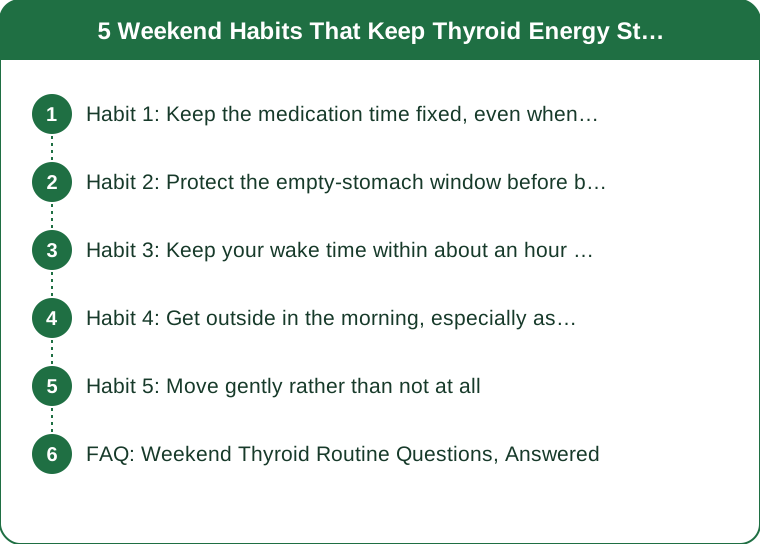
Habit 1: Keep the medication time fixed, even when you sleep in
The single most important habit of the five, and the easiest to lose on a Saturday.
Levothyroxine absorption is best on a consistent schedule, and a two-hour shift on both weekend days is enough to be noticeable for some people by Monday.
Take it at your weekday time and go back to sleep. Keep it on the bedside table with a glass of water. This works well and it is what many people settle on long term.
If you would rather not, keep the shift under an hour. Consistency matters more than the specific hour, but the shift itself is what causes the wobble.
Set the alarm for the dose, not for getting up. Two separate things, and separating them removes most of the tension between rest and routine.
Note what you actually do. A week of honest observation usually reveals a larger weekend drift than people expect.
And if your schedule genuinely cannot hold a morning dose, evening dosing is an option worth discussing with your doctor rather than tolerating an inconsistent morning one.
Habit 2: Protect the empty-stomach window before breakfast
The weekend breakfast is where this most often goes wrong.
Levothyroxine is best absorbed on an empty stomach, generally thirty to sixty minutes before food.
Weekend breakfasts arrive sooner after waking, because nobody is commuting, which compresses that window without anyone noticing.
Coffee is the specific problem. It can reduce absorption meaningfully, and weekend coffee tends to happen much earlier relative to the dose than weekday coffee does.
Calcium and iron are the other two to watch, and they need a four-hour separation rather than one hour.
A glass of water on waking, dose, then a slow start is the simplest structure, and it fits a weekend better than a weekday.
Use the window rather than resenting it. Shower, walk the dog, read. Thirty to sixty minutes is a genuinely pleasant weekend slot once it is a habit rather than a wait.
Habit 3: Keep your wake time within about an hour of weekdays
This is the habit that protects Monday specifically.
Social jet lag is real. Shifting sleep two or three hours later on weekend nights produces a genuine circadian shift, and Monday morning is when you pay for it.
Thyroid conditions frequently come with fatigue already, which means less capacity to absorb an additional circadian disruption.
Wake time anchors the rhythm more strongly than bedtime does. A late night with a normal wake time costs far less than a late morning.
A nap is a better tool than a lie-in. Twenty to thirty minutes in the early afternoon recovers sleep debt without moving the body clock.
Sunday night is where it shows. Difficulty sleeping on Sunday is usually a consequence of Saturday and Sunday mornings, not of anxiety about the week.
Aim for within an hour, which is realistic and achievable, rather than for identical wake times, which nobody sustains.

Habit 4: Get outside in the morning, especially as the days shorten
Ten to twenty minutes of daylight does more than it sounds like it should.
Morning light anchors the circadian rhythm more powerfully than any other available signal.
Even overcast daylight is far brighter than indoor lighting, typically by a factor of ten or more, so it works regardless of the weather.
Autumn is when this matters most. As daylight hours shrink, the average person’s light exposure drops sharply, and the effect on energy and mood is well documented.
Combine it with the medication window. A twenty-minute walk after the dose covers the empty-stomach period and the light exposure in the same slot.
Earlier is better than longer. Fifteen minutes at eight in the morning beats an hour at three in the afternoon for circadian purposes.
And it stacks with the wake-time habit. Consistent wake time plus morning light is a considerably stronger combination than either alone.
Habit 5: Move gently rather than not at all
The weekend is where the all-or-nothing pattern shows up most.
Fatigue makes intense weekend sessions tempting and counterproductive. A hard Saturday session that costs you Sunday is a poor trade when energy is already the limiting factor.
Twenty to thirty minutes of walking on both days does more for weekly energy consistency than one long session.
Gentle movement helps sleep quality, which feeds back into the whole system.
Cold intolerance makes outdoor movement harder in autumn. Dress for ten degrees colder than you expect and the barrier mostly disappears.
Two short sessions beat one long one for anyone managing fatigue, and they are far easier to actually do.
And listen to the pattern rather than the day. If Monday is consistently worse after an active weekend, the weekend was too hard — that is data, not a failure.
What Nobody Tells You
The weekend drift is cumulative. Two days of small shifts, every week, is a meaningful proportion of the year. Fixing the weekend is often worth more than optimising the weekdays further.
Track for two weeks before changing anything. Wake time, dose time, first food, and an energy score out of five. The pattern usually becomes obvious, and it is usually not what people expected.
FAQ: Weekend Thyroid Routine Questions, Answered
Does it matter if I take my thyroid medication later at weekends?
Consistency matters. A shift of two hours on both weekend days is enough for some people to notice by Monday. Taking it at your usual time and going back to sleep is a common and practical solution.
Can I have coffee sooner if I have already waited thirty minutes?
Coffee can meaningfully reduce levothyroxine absorption, so the usual advice is thirty to sixty minutes minimum, and longer is better. Weekend coffee tends to arrive much earlier relative to the dose than weekday coffee, which is why weekends are where this slips.
How much can I sleep in without upsetting my routine?
Aim for within about an hour of your weekday wake time. Wake time anchors the body clock more strongly than bedtime, so a late night with a normal wake time costs far less than a long lie-in.
This is general information, not medical advice. Talk to your doctor before changing anything about your medication schedule.
TL;DR:
- Keep the medication time fixed even if you go back to sleep. Consistency beats the specific hour.
- Protect the empty-stomach window. Weekend coffee arrives much earlier relative to the dose than weekday coffee.
- Keep wake time within an hour of weekdays. Wake time anchors the body clock; a nap beats a lie-in.
- Morning daylight and gentle movement on both days do more for Monday than one hard session does.
The weekend is where consistency is lost. Protecting two mornings is usually worth more than optimising five.
Keep Reading
This article is for general informational purposes only and is not medical advice. Always consult a qualified health professional for guidance specific to you.