Five Daily Anchors for Thyroid Fatigue as the Seasons Change
Quick Answer: Thyroid fatigue is worse when routine is unstable, and the shift from summer to fall destabilizes light exposure, meal timing and sleep all at once. Five anchors — fixed medication timing, morning light, protein at breakfast, a movement floor, and a hard evening cutoff — do more than any individual intervention, because they hold the variables steady while your body adjusts.
The seasons turning is not neutral if your thyroid is already asking for consistency.
Mornings get darker, schedules reshuffle, the pool routine ends, and the fatigue that felt manageable in July feels heavier by mid-September.
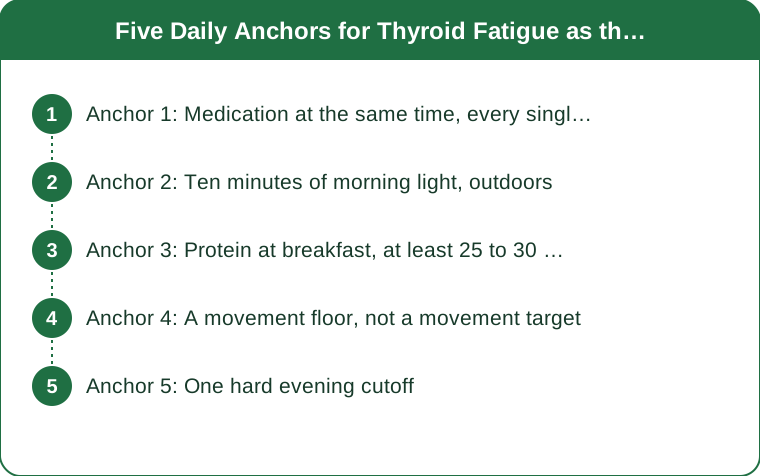
These are the five things worth anchoring. Not a program — anchors, which is a different and more achievable thing.

Anchor 1: Medication at the same time, every single day
This is the one with the most evidence behind it and the least room for improvisation.
Levothyroxine absorption is genuinely sensitive to what is in your stomach. Guidance is typically to take it on an empty stomach, 30 to 60 minutes before eating, and to keep the timing consistent day to day. Consistency matters as much as the specific window, because it makes your levels — and your lab results — interpretable.
The interactions worth knowing: calcium, iron, and magnesium supplements should be separated by about four hours, and coffee can reduce absorption if taken too close. Bedtime dosing is an option some people do well on, and it is worth raising with your clinician rather than switching unilaterally.
When the season changes and your morning shifts by 40 minutes, this is the first thing that quietly drifts. Set an alarm labeled with the actual reason, and put the bottle where you will see it. If mornings are chaotic, this is exactly the case where a bedtime schedule discussion is worth having.
This is general information, not medical advice. Dose and timing changes belong with your prescriber.
Anchor 2: Ten minutes of morning light, outdoors
As daylight shortens, morning light exposure drops before anyone consciously notices, and it is one of the strongest signals your circadian system gets.
Outdoor light — even on an overcast morning — is dramatically brighter than indoor lighting. A typical room sits around 100 to 300 lux; an overcast morning outside is 1,000 to 10,000 lux. That difference is the whole point, and it is why sitting by a window is a weaker version of stepping outside.
Aim for 10 minutes within the first hour of waking. Coffee on the step, the first part of a walk, standing outside while the dog does its business. It does not need to be exercise.
Why it matters here: circadian stability improves sleep quality, and poor sleep amplifies every symptom of thyroid fatigue. You are not treating the thyroid with sunlight. You are removing one of the things making the fatigue worse.
As mornings get darker through fall, this anchor gets harder and more valuable at the same time. If you are leaving in the dark by November, that is when a 10,000-lux lamp becomes worth considering.

Anchor 3: Protein at breakfast, at least 25 to 30 grams
Not because protein does anything to thyroid function, but because the mid-morning crash it prevents is often misattributed.
A carbohydrate-dominant breakfast produces a rise and fall in blood sugar that shows up as an 11am wall. When you already have baseline fatigue, that wall is easy to read as your thyroid getting worse.
A breakfast anchored on 25 to 30 grams of protein flattens that curve considerably and improves satiety through lunch. Practical versions: three eggs, Greek yogurt with nuts and seeds, cottage cheese on toast, or a shake if mornings are compressed.
There is a second reason this anchor earns its place: it has to happen after your medication window, which makes it a natural enforcement mechanism for anchor one. Medication, then light, then breakfast, in that order, is a sequence that holds itself together.
One caution worth naming: soy and very high-fiber breakfasts can interfere with levothyroxine absorption if they land in that window. Keep the gap and the problem does not arise.
Anchor 4: A movement floor, not a movement target
The mistake most people make with thyroid fatigue is setting a training goal and abandoning it during a bad week.
A floor works better. Define the smallest amount you will do regardless of how you feel — a 10-minute walk, five minutes of mobility, one flight of stairs on purpose. On good days you exceed it easily. On bad days you meet it and stay in the habit.
Why it matters: exercise capacity can be genuinely reduced with hypothyroidism, and pushing hard on a low-energy day tends to produce a multi-day setback. That cycle — overreach, crash, stop entirely — is far more damaging to fitness over a season than a modest consistent floor.
For structure, walking plus two short strength sessions a week is a reasonable target to build toward, with the floor as your guarantee. Strength work is especially worth protecting, since muscle mass is often affected and it responds to training regardless.
And log it somewhere. Fatigue distorts memory of what you have actually managed, and a week that felt like nothing often looks better on paper — which matters both for morale and for what you tell your clinician.
Anchor 5: One hard evening cutoff
Pick a single non-negotiable evening boundary and hold it. One, not five.
The highest-value candidates: screens off 45 minutes before bed, no food after a set hour, or lights dimmed at a fixed time. Any of the three works; trying to install all three at once works for about four days.
The reasoning is simple. Sleep quality is the biggest modifiable amplifier of thyroid fatigue, and evening is when it is decided. Evenings are also the least protected part of the day, because that is where every deferred task ends up.
A cutoff also solves a specific fall problem: as it gets dark earlier, evenings feel longer and stretch out. Without a boundary, bedtime drifts later while wake time stays fixed, and sleep debt accumulates quietly through October.
If you want a second thing, make it caffeine before 2pm — caffeine’s half-life is about five hours, so a late-afternoon coffee is still measurably present when you are trying to fall asleep.
Should I be tracking symptoms at all?
A simple 1 to 5 energy score each morning takes seconds and gives your clinician something more useful than a recollection. Patterns matter more than any single day.
When should I ask for retesting?
New or worsening fatigue, weight change, cold intolerance or mood change deserves a conversation rather than a routine adjustment — especially after a seasonal shift, when it is easy to attribute everything to the weather. This is general information, not medical advice.
Do I need to change anything else for fall?
Most people do not. Hold the five anchors steady through the transition and reassess in a month, rather than changing several things at once and losing track of what helped.
TL;DR:
- Seasonal transitions destabilize light, meals and sleep at once, which is why fatigue often worsens in early fall.
- Medication at a fixed time, on an empty stomach, separated from calcium, iron and coffee, is the non-negotiable anchor.
- Ten minutes of outdoor morning light and a 25 to 30 gram protein breakfast remove two of the biggest amplifiers.
- Set a movement floor rather than a target, and hold one evening cutoff instead of attempting five.
Five anchors, not a program. When energy is the limiting resource, the routines that survive are the ones that do not require any.
Keep Reading
This article is for general informational purposes only and is not medical advice. Always consult a qualified health professional for guidance specific to you.