Five Daily Habits That Quietly Affect Thyroid Medication Absorption
Quick Answer: Thyroid hormone replacement absorbs best on an empty stomach with water, and its absorption is measurably reduced by coffee, calcium, iron, fiber, and certain foods. Consistency matters as much as timing — the same routine daily produces steadier levels than a theoretically perfect but variable one.
Your labs came back and the number moved in the wrong direction, but nothing about your dose changed.
What changed was probably somewhere in the sixty minutes after you swallowed it.
Here are the five habits that most commonly interfere, and what to do about each.

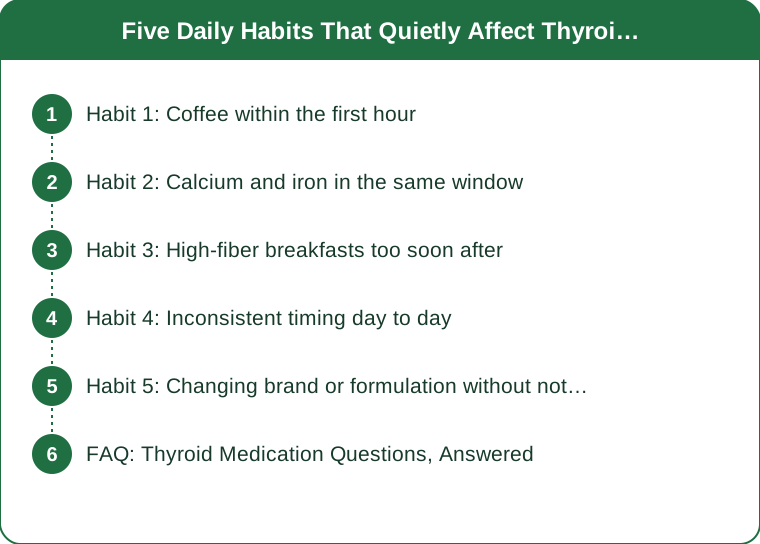
Habit 1: Coffee within the first hour
Coffee is the most common and most significant interferer. Studies on levothyroxine absorption have found that taking it with coffee can reduce absorption substantially compared to water alone, and espresso appears to have a stronger effect than filter coffee.
The mechanism appears to involve both the physical binding of the drug and accelerated gastric transit — the medication moves past the absorption window before it has fully dissolved.
What to do: wait 60 minutes after your dose before any coffee. If a full hour is unrealistic for your morning, this is one of the strongest arguments for switching to a bedtime dose instead, which several trials have found produces equal or better absorption.
Habit 2: Calcium and iron in the same window
Calcium carbonate and iron salts both bind thyroid hormone in the gut and form compounds that pass through unabsorbed. This is well established and clinically significant — it is one of the more common reasons for an unexplained rise in TSH.
It is not only supplements. Fortified plant milks, calcium-set tofu, antacids, and multivitamins containing either mineral all count.
What to do: keep calcium and iron at least 4 hours away from your thyroid dose in either direction. For most people that means thyroid medication first thing and any mineral supplement at lunch or dinner — which, conveniently, is also better timing for iron absorption anyway.
Habit 3: High-fiber breakfasts too soon after
Soluble fiber slows and reduces absorption of many oral medications, thyroid hormone included. A large bowl of bran cereal, oats, or a fiber supplement within the absorption window measurably lowers the amount that reaches your bloodstream.
This is one of the frustrating ones, because a high-fiber breakfast is otherwise a good choice. It is not the fiber that is the problem — it is the timing.
What to do: keep the 60 minute gap and eat whatever breakfast you like after it. If you take a fiber supplement, move it to the evening. And if you make a significant, lasting change to your daily fiber intake, mention it at your next appointment — a large sustained increase can shift your requirement slightly.

Habit 4: Inconsistent timing day to day
This one gets less attention than the others and may matter more. Thyroid hormone has a long half-life, so steady levels depend on steady input.
Taking it at 6am on weekdays and 10am on weekends, with breakfast some days and without on others, produces variable absorption that your labs will eventually reflect. A patient with a theoretically imperfect routine executed identically every day often has steadier levels than one with a perfect routine executed inconsistently.
What to do: pick a time you can genuinely hit every day including weekends, and hold it. If mornings are chaotic, bedtime dosing — at least 3 hours after your last food — is a legitimate, evidence-supported alternative worth raising with your prescriber.
Habit 5: Changing brand or formulation without noticing
Different manufacturers’ formulations are not always perfectly interchangeable, and pharmacies sometimes substitute generics between refills without a conversation.
Gel-cap and liquid formulations also behave differently from tablets — they are less affected by stomach acidity, which can matter for people on acid-reducing medication or with absorption issues.
What to do: check the manufacturer name on each refill. If it changed and you feel different or your next labs move, mention the substitution to your prescriber — it is a known and fixable variable, and pharmacies can usually flag your file to keep you on one manufacturer.
This is general information, not medical advice. Never change your dose or timing on your own — discuss any change with the clinician who manages your thyroid care, and retest 6 to 8 weeks after any change since levels take that long to stabilize.
FAQ: Thyroid Medication Questions, Answered
Is bedtime dosing really as good as morning?
Several randomized trials found bedtime dosing produced equal or slightly better absorption, likely because the stomach is genuinely empty and nothing follows for hours. It works well for people whose mornings involve immediate coffee or breakfast.
Does it matter what I drink it with?
Plain water, about 8 oz. Not juice, not milk, not coffee. Water volume actually helps — a full glass improves dissolution compared to a small sip.
Why do my symptoms not track my lab numbers?
Symptoms and TSH do not always correlate neatly, and many symptoms attributed to thyroid have overlapping causes including iron deficiency, vitamin D status, sleep, and perimenopause. Worth investigating rather than assuming the dose is wrong.
How soon after a change should I retest?
6 to 8 weeks. Testing earlier produces numbers that have not stabilized and can lead to unnecessary dose changes.
TL;DR:
- Coffee, calcium, iron, and high-fiber food all measurably reduce thyroid hormone absorption.
- Keep a 60-minute gap before food and coffee, and 4 hours from calcium or iron.
- Consistency beats perfection — the same routine daily produces steadier levels.
- Watch for manufacturer substitutions at refill, and always retest 6–8 weeks after any change.
If your labs drifted without a dose change, the explanation is usually sitting in your morning routine rather than in your thyroid. Fix the first hour of the day and the same prescription often starts doing what it was supposed to.
Keep Reading
This article is for general informational purposes only and is not medical advice. Always consult a qualified health professional for guidance specific to you.