Five Everyday Adjustments That Make Thyroid Fatigue More Manageable
Quick Answer: Thyroid fatigue is not ordinary tiredness and does not respond to pushing through. The five adjustments that help most: consistent medication timing on an empty stomach, protected sleep timing, energy pacing rather than bursts, temperature management, and strength work over cardio bursts. None replaces treatment — all make the treated state easier to live in.
The medication is the treatment.
The day around it is what you actually live.
These are the five things that change how that day goes.

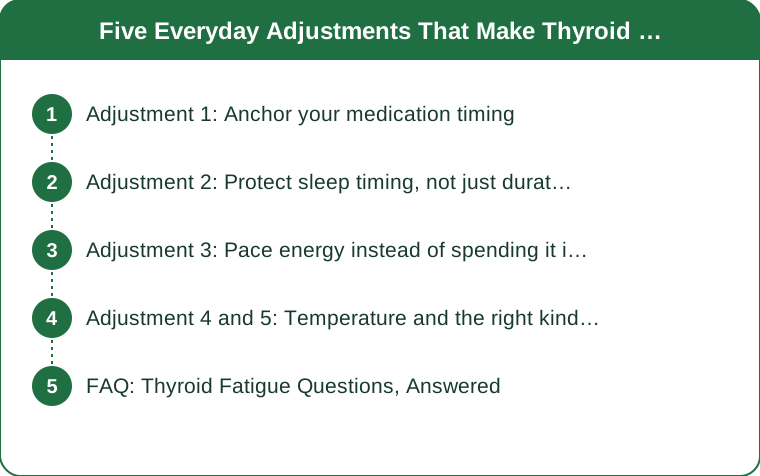
Adjustment 1: Anchor your medication timing
Levothyroxine absorption is genuinely sensitive to what is around it, and consistency matters more than perfection.
Take it on an empty stomach, at the same time daily. Typically 30-60 minutes before breakfast, or at bedtime 3-4 hours after eating if mornings are impossible. What matters most is that it is the same every day, because your dose was titrated to a particular absorption pattern.
Keep calcium and iron 4 hours away. Both bind levothyroxine and substantially reduce absorption. This includes calcium-fortified plant milks and multivitamins containing iron, which people frequently overlook.
Coffee needs a gap too. Coffee reduces levothyroxine absorption meaningfully. Wait 30-60 minutes after the tablet before your first cup — a genuinely annoying rule that makes a measurable difference.
Do not switch brands casually. Different formulations can differ slightly in absorption. If your pharmacy substitutes a brand, mention it to your doctor, particularly if you notice a change in how you feel.
Set an alarm and use a pill organiser. Missed and doubled doses are the most common cause of unexplained fluctuation, and both are entirely preventable.
This is general information, not medical advice — dosing, timing and testing are decisions for you and your doctor, and any change in symptoms deserves a conversation rather than a self-adjustment.
Adjustment 2: Protect sleep timing, not just duration
Thyroid fatigue and poor sleep amplify each other, and timing consistency is the lever most people have not tried.
Keep wake time constant, including at weekends. A consistent wake time anchors your circadian rhythm more effectively than a consistent bedtime, and circadian stability improves sleep quality independent of duration.
Get daylight within an hour of waking. 10-15 minutes outside is one of the strongest available signals for a stable sleep-wake cycle, and it is more effective than indoor light by a wide margin.
More sleep is not automatically better. Thyroid fatigue does not resolve with extra hours the way sleep debt does, and long unstructured sleep can fragment the rhythm further. Seven to nine hours, consistently timed, beats ten hours at random times.
Watch the afternoon nap. A short nap of 20 minutes before 3pm can help. Longer or later naps commonly worsen night sleep and deepen the cycle.
Treat night-time symptoms as information. Difficulty sleeping, or waking unrefreshed despite adequate hours, is worth reporting — it may reflect dose, or something else entirely.
Seasonal note: autumn’s shrinking daylight makes the morning light habit both harder and more valuable. As sunrise moves later through September and October, getting outside early takes deliberate scheduling, and it is exactly when the circadian anchor matters most.

Adjustment 3: Pace energy instead of spending it in bursts
The most common pattern in thyroid fatigue is a good day spent entirely, followed by two bad ones.
Work to about 70 percent of what you feel capable of on a good day. Stopping while you still have something left is what prevents the crash. This is the single hardest and most effective adjustment on the list.
Break tasks into blocks with real breaks. 25-40 minutes of activity, then a genuine rest — sitting down, not switching tasks. Task-switching is not rest.
Plan demanding things for your best window. Most people have a reliable few hours. Identify yours and defend it for what actually matters rather than spending it on email.
Say no with a plan rather than an apology. Declining a commitment is a legitimate energy decision. It is easier when you have decided your limits in advance rather than in the moment.
Track patterns for a fortnight. A simple daily note of energy, sleep and activity reveals patterns that are invisible day to day, and it makes appointments considerably more productive.
Expect variability. Good and bad days are a feature, not a sign you have done something wrong. Planning that assumes every day is a good day is what produces the boom-and-bust cycle.
Adjustment 4 and 5: Temperature and the right kind of exercise
Adjustment 4: Manage temperature actively
Cold intolerance is one of the most common and least discussed symptoms, and it is a genuine drain on energy.
Layer rather than heat. Multiple thin layers trap air more effectively than one thick one, and let you adjust through the day rather than swinging between too hot and too cold.
Protect extremities first. Hands and feet lose heat fastest and are usually where cold intolerance is felt. Warm socks and a decent pair of gloves change a day more than a thicker coat does.
Warm up before exercising, longer than feels necessary. Cold muscles plus fatigue is a poor combination, and an extra 10 minutes improves both the session and how you feel afterwards.
Clothing that is comfortable to move in matters here. Being cold and being restricted are both energy costs. Soft, well-fitting layers you can add and remove easily are a practical tool, not a luxury.
Adjustment 5: Choose strength work over cardio bursts
Resistance training is generally better tolerated than high-intensity cardio in thyroid fatigue, because it has built-in rest between sets and does not produce the same prolonged after-effect.
Start smaller than you think. Two sessions a week, 20-30 minutes, 5-6 basic movements, 2 sets each. Build only when the current level feels genuinely comfortable.
Walking is underrated. Consistent daily walking is well tolerated, supports mood and sleep, and does not produce the crash that harder sessions can.
Judge a session by the next day, not by the session. If you are wiped out the following day, it was too much regardless of how it felt at the time. Speak to your doctor before starting a new exercise programme, particularly if your thyroid levels are not yet stable.
FAQ: Thyroid Fatigue Questions, Answered
When should I take levothyroxine?
On an empty stomach, 30-60 minutes before breakfast, or at bedtime 3-4 hours after eating. Same time every day matters most.
How long should I wait before coffee?
30-60 minutes. Coffee measurably reduces absorption.
What should I keep away from my tablet?
Calcium and iron by 4 hours — including fortified plant milks and multivitamins.
Will more sleep fix the fatigue?
No. Thyroid fatigue does not clear with extra hours. Consistent timing of 7-9 hours helps more than longer sleep at random times.
What exercise is best tolerated?
Resistance training and walking. Start at two 20-30 minute sessions a week and judge them by how you feel the next day.
Why am I always cold?
Cold intolerance is a common symptom. Layer, protect hands and feet first, and warm up longer before exercise.
When should I go back to my doctor?
If symptoms change or persist despite stable treatment, if a brand substitution coincides with feeling different, or before starting a new exercise programme.
TL;DR:
- Same time, empty stomach, every day — and keep calcium and iron 4 hours away, coffee 30-60 minutes.
- Consistent wake time plus morning daylight does more than extra sleep hours.
- Pace at about 70 percent on good days to prevent the crash that follows.
- Layer for temperature and protect hands and feet first.
- Strength work and walking are better tolerated than high-intensity bursts — judge sessions by the next day.
Start with the medication timing this week. It is the one with the clearest mechanism and the easiest to make automatic.
Keep Reading
This article is for general informational purposes only and is not medical advice. Always consult a qualified health professional for guidance specific to you.