Five Thyroid Signs That Show Up First When the Weather Turns Cold
Quick Answer: Thyroid hormone regulates heat production, so cold weather makes an underactive thyroid more noticeable - cold intolerance, fatigue, dry skin, hair changes, and slowed digestion all become more visible in autumn. The difficulty is that seasonal tiredness looks identical from the outside. The distinguishing feature is persistence and pattern, and a blood test is the only way to know.
Everybody is tired in October and everybody is cold. That is exactly the problem.
If your thyroid is underactive, this is the season where it stops hiding, and it is also the season where every symptom has a perfectly reasonable alternative explanation. Here is what tends to show first, and what actually distinguishes one from the other.
This is general information, not medical advice - only a blood test and a clinician can diagnose a thyroid problem.

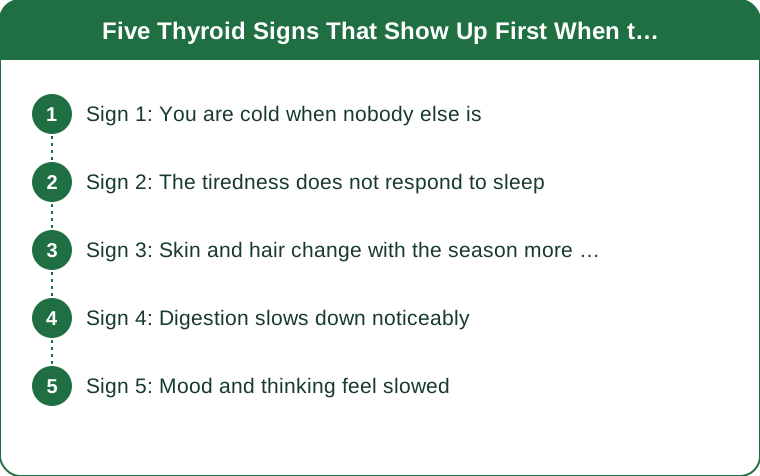
Sign 1: You are cold when nobody else is
Thyroid hormone is a primary regulator of basal metabolic rate, which is essentially how much heat your body produces at rest. When levels are low, heat production falls, and the result is a persistent feeling of cold that does not respond to layers.
The distinguishing feature is not that you feel cold in October - everyone does. It is the comparison. Being cold in a room where other people are comfortable, wearing more layers than the people around you, and being cold in situations that never used to be cold is the pattern worth noticing.
Cold hands and feet specifically are common and less specific, since circulation, low body fat, and simply being tall all contribute. It is generalised cold - a feeling of being cold through the body that a jumper does not fix - that is more telling.
The seasonal version of this matters because it is often the first thing that changes. Many people with mild hypothyroidism get through summer without noticing anything and find that October is when something first seems wrong. That timing is not a coincidence, and it is worth taking seriously rather than filing under seasonal grumbling.
Sign 2: The tiredness does not respond to sleep
Autumn tiredness is real and it has ordinary explanations - less daylight, disrupted circadian timing, and the general accumulation of a school or work year.
Thyroid fatigue is different in one specific way: it does not resolve with rest. A well-slept weekend improves ordinary seasonal tiredness noticeably. Hypothyroid fatigue tends to persist through good sleep, and people often describe waking unrefreshed after eight or nine hours.
There is also a quality difference that people report consistently. Ordinary tiredness feels like wanting to sleep. This tends to feel more like heaviness or slowness - a sense that everything takes more effort than it should, including thinking.
The practical test is a two-week one. If you can arrange a stretch of genuinely good sleep and the fatigue is unchanged, that is meaningful information to bring to a doctor. It is also worth noting that low iron, low vitamin D, depression, sleep apnoea, and perimenopause all produce similar fatigue, which is precisely why this needs a blood test rather than a self-assessment.

Sign 3: Skin and hair change with the season more than usual
Everyone’s skin gets drier when the heating comes on, and everyone sheds a little more hair in autumn - seasonal shedding is a documented and normal phenomenon.
What is worth noticing is the degree and the persistence. Hypothyroidism slows cell turnover, which produces skin that is dry in a way moisturiser does not fix, and hair that becomes coarse, brittle, or thin diffusely across the scalp rather than in patches.
A specific and somewhat classic sign is thinning of the outer third of the eyebrows, which is worth a look in the mirror because most people never think to check it.
Nails often change too - becoming brittle, ridged, or slower growing.
Again, the distinguishing feature is that the seasonal explanation does not fully account for it. Dry skin that started in October and improves with a richer moisturiser is seasonal. Dry, coarse skin that has been getting worse since summer and does not respond to anything is worth mentioning.
Sign 4: Digestion slows down noticeably
Thyroid hormone influences gut motility, and low levels slow it. Constipation is one of the more common hypothyroid symptoms and one of the least discussed.
Autumn provides a convenient alternative explanation - less activity, changed diet, less water because you feel less thirsty in cool weather. All of those are real contributors and all of them are easy to test by addressing them.
If fibre, fluid, and movement have all been genuinely addressed for a few weeks and nothing changes, that persistence is the signal.
Related changes worth noting include bloating, a feeling of fullness after small meals, and unexplained weight change. Weight gain is the symptom most associated with thyroid problems in the popular imagination and it is one of the less reliable ones - the amount attributable to an underactive thyroid is usually modest, and attributing significant weight change to thyroid function alone is often misleading. Its value is as one piece of a pattern rather than as evidence on its own.
Sign 5: Mood and thinking feel slowed
Low mood, difficulty concentrating, and a general mental sluggishness are common thyroid symptoms and are the ones most often attributed to the season.
This is genuinely difficult to distinguish, because reduced daylight has well-documented effects on mood, and seasonal affective patterns are common and real.
The features that push toward investigating thyroid function rather than assuming seasonality are: symptoms that started before the light changed, symptoms that persist through bright days and holidays, and the presence of the physical signs above alongside the mood changes.
The overall pattern matters far more than any single symptom. Cold intolerance alone is not much. Cold intolerance plus unrefreshing fatigue plus dry skin plus slowed digestion plus low mood, all present together and all worsening over months, is a pattern that warrants a blood test.
The test itself is straightforward - a TSH and often a free T4, done from an ordinary blood draw, widely available and inexpensive. If you recognise several of these signs, the useful next step is to see a doctor and ask for thyroid function to be checked, rather than to research further. Thyroid conditions are common, particularly in women, they are readily diagnosed, and they are treatable. Please treat everything here as general information rather than as a substitute for a clinician who can actually assess you.
TL;DR:
- Thyroid hormone drives heat production, so cold weather makes an underactive thyroid more noticeable - which is why autumn is when many people first suspect something.
- The five signs that surface first: feeling cold when others are not, fatigue that sleep does not fix, dry skin and coarse or thinning hair, slowed digestion, and slowed mood and thinking.
- Each one has an ordinary seasonal explanation, so the distinguishing features are persistence, pattern, and failure to respond to the obvious fix.
- Weight change is the most famous symptom and one of the least reliable on its own.
If several of these are present together and getting worse, ask a doctor for a thyroid function test. It is a simple blood test, the conditions it detects are common and treatable, and October is when the pattern is easiest to see. This article is general information and not medical advice.
Keep Reading
This article is for general informational purposes only and is not medical advice. Always consult a qualified health professional for guidance specific to you.