Five Thyroid Symptoms That Get Blamed on the End of Summer
Quick Answer: Fatigue, weight change, hair shedding, feeling cold and low mood all spike in late summer for entirely ordinary reasons - schedule change, seasonal hair cycling, less daylight. They are also the five most common presentations of an underactive thyroid. The distinguishing features are duration and pattern: seasonal complaints track the calendar and improve with rest, while thyroid symptoms persist through good weeks, appear together rather than singly, and do not respond to sleeping more. Five weeks of it is worth a blood test, not a shrug.
Every September the same conversation happens.
You are tired, you feel colder than everyone else, and someone tells you it is just the end of summer - and most of the time they are right.

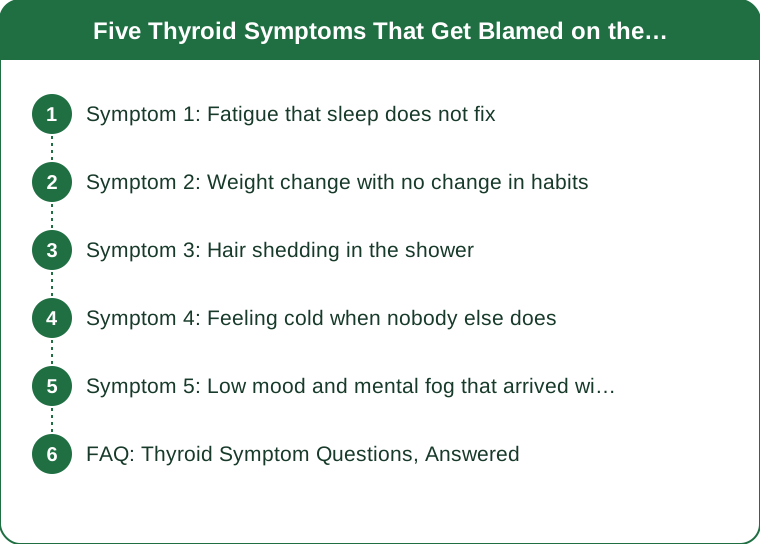
Symptom 1: Fatigue that sleep does not fix
Seasonal tiredness responds to rest. A long weekend, two good nights and a lighter week produce a noticeable improvement.
Thyroid fatigue does not. People describe sleeping nine hours and waking unrefreshed, week after week, regardless of what the schedule looks like.
The physical quality is different too. It is often described as heaviness in the limbs rather than sleepiness, and it is present from the moment of waking rather than building through the day.
Exercise tolerance is the useful test. Seasonal tiredness usually improves after a walk; thyroid-related fatigue frequently gets worse after activity that used to be easy.
And it does not have good days. The absence of a single good week over a month or more is the signal worth acting on.
If two consecutive restful weeks changed nothing, the calendar is probably not the explanation.
Symptom 2: Weight change with no change in habits
Late summer weight fluctuation is usually water and routine. Heat, salt, travel and a disrupted schedule move the scale several pounds in either direction within days.
Thyroid-related weight change is slower and steadier - a gradual gain of five to fifteen pounds over months, without a corresponding change in eating or activity.
It is often accompanied by puffiness rather than fat gain, particularly around the face, hands and ankles, which is fluid retention rather than tissue.
Resistance to normal correction is telling. Returning to the usual routine for four to six weeks would ordinarily reverse a seasonal fluctuation.
Weight alone is a weak signal - it is only meaningful alongside the other items on this list.
And unexplained weight loss with heat intolerance and a racing heart points the opposite direction, toward an overactive thyroid, which is equally worth investigating.
Symptom 3: Hair shedding in the shower
Seasonal shedding is real and well documented. A larger proportion of hair follicles enter the shedding phase in late summer, producing a noticeable increase in September and October that resolves on its own.
Thyroid-related hair loss is diffuse rather than patchy, thinning across the whole scalp rather than at a parting or in circles.
Texture change is the more specific clue. Hair becoming dry, coarse or brittle alongside the shedding is more suggestive than volume alone.
The outer third of the eyebrows thinning is a classic and frequently overlooked sign.
Duration separates them. Seasonal shedding settles within about three months; thyroid-related shedding continues.
And it lags behind the cause by weeks, so shedding now may reflect something that started in early summer, which is why the timing can be misleading in both directions.

Symptom 4: Feeling cold when nobody else does
This one gets dismissed most in late summer because everyone else is complaining about heat, so being cold reads as a personality trait rather than a symptom.
Thyroid hormone sets metabolic rate, and reduced output means less heat production - being cold is one of the most direct consequences.
The pattern is being cold in ordinary conditions, in air conditioning that nobody else notices, or needing a layer indoors in August.
Cold hands and feet specifically are common, often with dry skin on the same extremities.
It is a good discriminator because seasonal fatigue does not cause cold intolerance, so the two together are more meaningful than either alone.
And it is the symptom people are least likely to mention to a doctor, which is exactly why it is worth writing down.
Symptom 5: Low mood and mental fog that arrived with the schedule change
September mood dips are extremely common and usually track daylight, schedule intensity and the end of summer flexibility.
Thyroid-related low mood typically comes with slowing - slower thinking, word-finding difficulty, reduced concentration - rather than sadness alone.
Apathy is described more often than distress, a flatness rather than a low, which is a subtly different picture.
It travels with the physical symptoms. Low mood alone is far more likely to be situational; low mood plus cold intolerance plus unrefreshing sleep is a cluster.
It does not lift with the usual levers - exercise, social contact, a good week - which would ordinarily shift a seasonal dip.
And it is more common than assumed, which is why thyroid function is a standard early test when depressive symptoms present with physical features.
Five weeks, several symptoms together, no response to rest - that is the threshold for a blood test rather than a shrug.
This is general information, not medical advice.
FAQ: Thyroid Symptom Questions, Answered
What test should I ask for?
TSH is the standard first test. Free T4 alongside it gives a fuller picture, and thyroid antibodies are relevant if there is a family history or an autoimmune condition.
Does the time of day matter for testing?
TSH is somewhat higher in the early morning and lower in the afternoon. Testing consistently in the morning makes results easier to compare over time.
Should I stop biotin supplements before a test?
Yes - biotin interferes with many thyroid assays and can produce misleading results. Most labs suggest stopping two to three days beforehand.
How common is this?
Thyroid disorders are substantially more common in women than men, and risk increases with age, so it is a reasonable thing to check rather than an exotic diagnosis.
Can a normal TSH still mean symptoms are thyroid-related?
It can be more complicated, which is why the full picture and a clinician matter. A single normal result with persistent clustered symptoms is worth a follow-up conversation rather than a full stop.
How long should I wait before getting checked?
If several of these persist for more than four to six weeks and do not improve with rest, get the blood test. It is inexpensive and it settles the question.
This is general information, not medical advice.
TL;DR:
- Late-summer fatigue, weight change, shedding, cold and low mood look almost identical to hypothyroid symptoms.
- Seasonal versions improve with rest and track the calendar; thyroid versions persist and cluster.
- Cold intolerance in August and thinning outer eyebrows are the most specific clues.
- Diffuse thinning with texture change lasting beyond three months is worth investigating.
- Several symptoms together for four to six weeks means ask for TSH and free T4 - and pause biotin first.
Most of the time it really is the season. Checking costs one blood test.
Keep Reading
This article is for general informational purposes only and is not medical advice. Always consult a qualified health professional for guidance specific to you.