5 Ways to Protect Your Energy as the Daylight Disappears
Quick Answer: Autumn brings two things that overlap with hypothyroid symptoms — less daylight and colder temperatures — which can make existing fatigue and cold intolerance feel considerably worse without anything having changed medically. The five adjustments below target light exposure, warmth, medication consistency, movement, and food timing. If symptoms shift meaningfully, that is a reason to get labs checked, not to push through.
You know your baseline. And every October it slips, and every year you wonder whether something has changed.
Sometimes it has, and sometimes the season is simply stacking on top of symptoms you already manage. Both are worth taking seriously. Here are five specific adjustments that address the seasonal half of it.

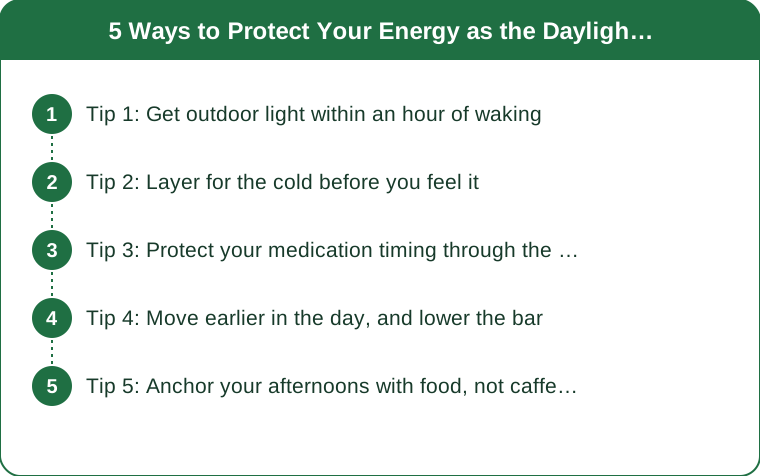
Tip 1: Get outdoor light within an hour of waking
Morning light is the single strongest signal your body uses to set its circadian rhythm, and that rhythm governs when you feel alert, when you feel tired, and how well you sleep — all of which interact with how fatigue is experienced.
In autumn, the problem is not just less total light. It is that the light arrives later, so many people now wake, commute, and arrive at work entirely in the dark. Your body gets its first bright light signal hours after waking, or not at all.
The adjustment: get outside for ten to fifteen minutes within an hour of waking, without sunglasses. Even a fully overcast day delivers far more light intensity than indoor lighting. Coffee on a doorstep counts. A walk to a further bus stop counts.
If genuine outdoor time is not possible, a light therapy lamp used in the morning is a reasonable substitute and is well studied for seasonal mood changes. Position it to the side rather than staring at it, and use it consistently at the same time.
Why this matters specifically here: fatigue that comes from a shifted circadian rhythm feels very similar to fatigue from other causes, and it is one of the few contributors you can change in ten minutes a day. Sorting it out also makes it clearer whether something else is going on underneath.
Tip 2: Layer for the cold before you feel it
Cold intolerance is a common hypothyroid symptom, and autumn is the season where it moves from background to foreground.
The instinct is to add a big coat for going outside. The more useful adjustment is warmth at the periphery, continuously — hands, feet, and the base of the neck — because those are where the discomfort concentrates and where being cold drives the whole-body tension and hunching that costs energy.
The adjustment: build a set of habits rather than one purchase.
Warm socks and proper footwear indoors as well as out. Cold feet on a hard floor at home is a constant low-grade drain.
A layer you can add and remove easily, so you are not either cold or overheating. A cardigan at your desk, a vest at home.
Something warm at the neck. A scarf indoors sounds odd until you try it during a cold week.
A warm drink as a warming tool, not just a comfort. It genuinely helps, and it supports hydration, which people neglect in cold weather because they are less thirsty.
One note worth flagging: a meaningful change in cold intolerance — feeling much colder than you did last winter at the same doses and routines — is exactly the kind of symptom shift worth mentioning to your clinician. This is general information, not medical advice.

Tip 3: Protect your medication timing through the schedule change
Thyroid medication absorption is genuinely sensitive to timing and to what else is in your stomach, and autumn disrupts routines in ways that quietly break a habit that had been working all summer.
What changes in autumn: school schedules, darker mornings that push wake-up times later, clock changes, and more rushed mornings. All of them can shift when you take your medication relative to food and coffee.
The adjustment: anchor the timing to something that does not change.
Take it at the same clock time every day, and when the clocks change, decide deliberately which clock time you are keeping rather than drifting.
Keep the gap before food and coffee consistent. Coffee in particular is well documented to interfere with absorption when taken too close to the dose — this is the most common accidental disruption there is, and dark mornings make people reach for coffee sooner.
Watch new supplements. Autumn is when many people start vitamin D, iron, or a multivitamin. Calcium and iron in particular affect absorption and need separation by several hours.
Set a reminder if the routine has shifted. A habit anchored to a summer morning routine does not survive a different autumn one, and this is worth solving actively rather than relying on memory.
Any change to medication, dose, or timing is a conversation with your prescriber. This is general information, not medical advice.
Tip 4: Move earlier in the day, and lower the bar
Exercise helps fatigue, which is one of the crueler facts about fatigue, because it is hardest to do when you most need it. Autumn adds two obstacles: darkness at both ends of the day, and cold making the start of any session less appealing.
The adjustment: move the movement earlier and make it smaller.
Earlier because it stacks with the morning light exposure from Tip 1, and because energy for a workout after a dark, cold afternoon is scarcer than energy before the day has drained it.
Smaller because consistency matters far more than session quality here. Fifteen minutes done four times a week outperforms an hour planned twice and skipped.
What to prioritize: gentle strength work and walking. Strength training supports muscle mass and bone density, both of which are relevant considerations for thyroid conditions, and walking is the most reliably repeatable thing there is.
Warm up longer than in summer. Cold tissue is stiffer, and starting a session cold in October is where minor strains happen.
Adjust expectations honestly. Fatigue that comes with a thyroid condition is not the same as being unmotivated, and workouts that felt easy in June may not now. Scaling the session is the correct response, not a failure of discipline.
If exertion tolerance has changed substantially, that is symptom information worth bringing to an appointment rather than something to train through.
Tip 5: Anchor your afternoons with food, not caffeine
The mid-afternoon dip deepens in autumn — light is falling, the day has been long, and it is dark by the time you would normally get a second wind.
The default response is more coffee. In the afternoon that trades a small short-term lift for worse sleep, and worse sleep makes the next day’s fatigue worse. It is a loop that compounds over a season.
The adjustment: make lunch and the mid-afternoon do the work.
Include protein at lunch, reliably. A carbohydrate-heavy lunch produces a larger blood sugar swing and a deeper afternoon dip. Protein and fiber flatten it.
Plan a real afternoon snack rather than improvising one. Something with protein and some fat — nuts, yogurt, cheese and fruit — holds better than a purely sweet option.
Set a caffeine cutoff time. Caffeine has a long half-life and afternoon coffee measurably affects sleep quality even in people who fall asleep fine. Early afternoon at the latest.
Take the dip seriously as information. A ten-minute walk outside during the dip addresses light exposure, movement, and the mental reset simultaneously, and it works better than the coffee does.
Keep hydrating. Thirst drops in cool weather while your needs do not, and mild dehydration presents as fatigue and headache — a small, common, entirely fixable contributor that gets overlooked every autumn.
If fatigue is worsening despite these adjustments, or is accompanied by other symptom changes, that is a reason to have your levels checked rather than to keep optimizing your routine.
TL;DR:
- Morning outdoor light within an hour of waking is the highest-value seasonal adjustment.
- Warmth at the hands, feet, and neck matters more than one heavy coat.
- Autumn schedule changes quietly disrupt medication timing — anchor it to a fixed clock time.
- Move earlier and smaller; consistency beats session quality when fatigue is in the picture.
- Protein at lunch and a caffeine cutoff protect the afternoon better than more coffee does.
The reason to make these five adjustments deliberately is that they separate the seasonal load from everything else. If you have handled light, warmth, timing, movement, and food, and your baseline still slipped, that is genuinely useful information to bring to your clinician instead of a vague sense that autumn is always like this. Start with the morning light this week — it costs ten minutes and it is the one most likely to move something.
Keep Reading
This article is for general informational purposes only and is not medical advice. Always consult a qualified health professional for guidance specific to you.