5 Fall Food Swaps That Support Thyroid Energy When the Light Changes
Quick Answer: As daylight shortens, most people shift toward heavier, carbohydrate-dense comfort foods and less sun exposure — both of which can compound the fatigue and sluggishness that already come with an underactive thyroid. Five swaps do most of the work: root vegetables in place of refined starches, a protein-forward breakfast in place of a carb-only one, vitamin D-rich foods alongside a tested supplement plan, selenium and iodine sources kept steady, and a warm-drink habit that doesn’t collide with medication timing.
The first genuinely cold week arrives and everything gets harder. Getting up, staying warm, staying awake after 3pm. If your thyroid is already running slow, autumn adds a second load onto the first — and food is one of the few levers you fully control.

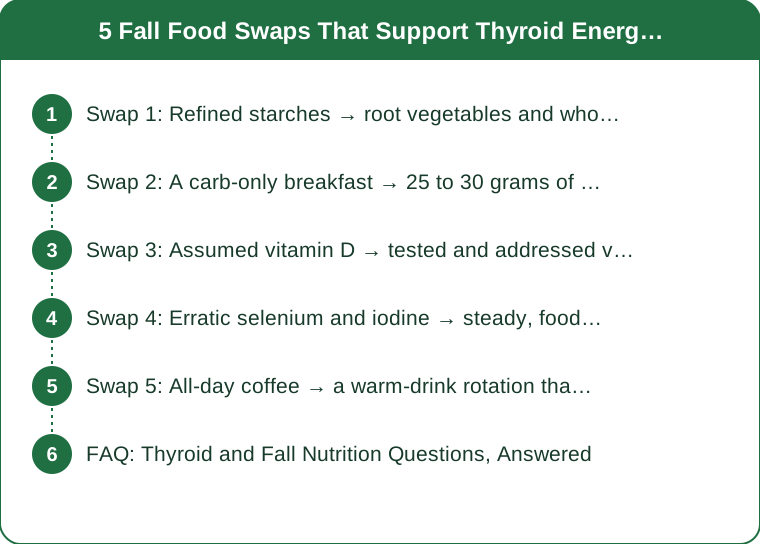
Swap 1: Refined starches → root vegetables and whole grains
The comfort-food pull in autumn is real, and the usual landing spot is white bread, pasta, and pastry. Those produce a fast glucose rise and a matching drop, and that drop lands directly on top of the afternoon fatigue that many people with hypothyroidism already experience.
Root vegetables give you the same warmth and satisfaction with fiber attached: roasted sweet potato, butternut squash, carrots, parsnips, and beets. The fiber slows absorption enough to flatten the curve, and the volume is genuinely filling.
Practical version: roast a large tray on Sunday — sweet potato, squash, and red onion in olive oil at 425°F for 30 minutes — and use it across three or four meals. Add it to grain bowls, eggs, or alongside protein.
Whole grains that hold up: steel-cut oats, farro, barley, quinoa. All work in the warm, soft, comforting register that autumn cravings are actually asking for.
What this changes: steadier energy across the afternoon, and less of the 3pm crash-and-snack cycle that turns into a daily habit by November.
Swap 2: A carb-only breakfast → 25 to 30 grams of protein
Toast, cereal, or a pastry with coffee is the standard autumn morning, and it’s the meal most likely to be leaving energy on the table.
Protein at breakfast steadies blood sugar across the whole morning and improves satiety in a way carbohydrate alone doesn’t. For anyone dealing with thyroid-related fatigue, a morning that doesn’t include a mid-morning crash is a meaningfully different day.
Targets that hit 25 to 30 grams:
- Three eggs with a slice of whole grain toast — about 20g, add cheese or a side of cottage cheese to clear 30
- Greek yogurt, one cup, with nuts and berries — about 20 to 25g
- Cottage cheese with roasted squash and pumpkin seeds — about 28g
- A protein smoothie with milk, protein powder, and frozen berries — 30g easily
The timing complication that matters here: if you take levothyroxine, it’s typically recommended on an empty stomach 30 to 60 minutes before eating, and calcium and iron can interfere with absorption for several hours. A yogurt or cottage cheese breakfast eaten too close to the dose is a real absorption issue, not a theoretical one.
Workable sequence: medication on waking, then breakfast 45 to 60 minutes later. If your breakfast is dairy-heavy, that gap matters more, not less.
Discuss medication timing with your prescribing clinician — individual guidance varies.
Swap 3: Assumed vitamin D → tested and addressed vitamin D
From roughly October through March, sun exposure in much of the northern United States is insufficient for meaningful vitamin D synthesis, regardless of how much time you spend outdoors. Deficiency is common and its symptoms — fatigue, low mood, muscle aches — overlap almost perfectly with under-treated hypothyroidism, which makes it easy to attribute everything to the thyroid.
Food sources, realistically: fatty fish is the strongest — salmon, mackerel, sardines. Egg yolks, fortified milk and plant milks, and UV-exposed mushrooms contribute smaller amounts. Food alone rarely closes a genuine deficiency, which is why testing matters more than diet tweaks here.
The practical move: ask for a 25-hydroxyvitamin D test at your next thyroid panel. It’s a simple add-on and it turns guesswork into a number.
Why this belongs in a thyroid conversation: there’s an observed association between low vitamin D status and autoimmune thyroid conditions, though the direction of that relationship isn’t settled. What is clear is that correcting a documented deficiency addresses a fatigue source you’d otherwise keep attributing to your thyroid dose.
Two fatty fish meals a week through autumn and winter is a reasonable food-side habit regardless — salmon, sardines on toast, or a mackerel salad each count.
This is general information, not medical advice. Test before supplementing and follow your clinician’s guidance on dose.

Swap 4: Erratic selenium and iodine → steady, food-first intake
These two minerals matter directly for thyroid function, and both are easier to get wrong through enthusiasm than through neglect.
Selenium is required for the enzymes that convert T4 to the active T3. Deficiency is uncommon in the US but not unheard of. Two Brazil nuts a day covers the requirement comfortably — and more than about four daily can approach the upper safe limit, since selenium content per nut varies enormously. Other good sources: tuna, sardines, eggs, sunflower seeds.
Iodine is the substrate for thyroid hormone itself, and here the relationship is genuinely U-shaped. Both too little and too much cause problems, and excess iodine can worsen autoimmune thyroid conditions in some people. Iodized salt, dairy, eggs, and fish cover typical needs.
The autumn-specific risk: kelp and seaweed supplements are heavily marketed as thyroid support and can deliver iodine doses many times the daily requirement. These are the single most common way people accidentally destabilize their thyroid with a supplement.
Cruciferous vegetables — kale, broccoli, cabbage, Brussels sprouts, all of which come into season now — contain goitrogens, which is the source of a persistent worry. In practice, normal culinary amounts are not a problem for people with adequate iodine intake, and cooking reduces the compounds further. Roast the Brussels sprouts.
The steady approach beats the optimized one: consistent, ordinary food sources, no high-dose thyroid supplements without clinician input.
This is general information, not medical advice.
Swap 5: All-day coffee → a warm-drink rotation that respects your dose
Autumn brings a natural increase in warm drinks, and two things go wrong at once.
Coffee interferes with levothyroxine absorption. Studies have found meaningfully reduced absorption when the medication is taken with coffee, which is why the standard advice is to wait — commonly 30 to 60 minutes — before your first cup. This is the most frequently broken rule in thyroid management, because medication and coffee are both morning rituals and they collapse into one.
And afternoon caffeine compounds the sleep problem. Caffeine has a half-life of roughly 5 to 6 hours in most adults, so a 3pm coffee leaves meaningful levels at bedtime. Poor sleep worsens fatigue, which prompts more afternoon coffee, which worsens sleep.
The rotation that works:
- On waking: medication with water only
- 45 to 60 minutes later: coffee, with breakfast
- Mid-morning: more coffee if you want it — this is the safe window
- After 2pm: switch to something caffeine-free — herbal tea, rooibos, warm lemon water, or decaf
- Evening: chamomile or a warm milk drink, if that suits you
Rooibos in particular works well as an autumn afternoon drink: no caffeine, no tannin bitterness even when over-steeped, and it holds up in a travel mug.
What this changes: better medication absorption, which shows up in your labs, and better sleep, which shows up in everything else.
Discuss any medication timing changes with your prescribing clinician.
FAQ: Thyroid and Fall Nutrition Questions, Answered
Do I need to avoid cruciferous vegetables entirely?
No. Normal culinary amounts of kale, broccoli, and cabbage are not a problem for people with adequate iodine intake, and cooking reduces goitrogenic compounds further. The concern applies to very large raw quantities — the level of daily raw kale juice, not a side of roasted broccoli.
Should I take a thyroid support supplement in winter?
Generally no, and kelp-based ones carry real risk of excess iodine. If you suspect a nutrient gap, test for it — vitamin D, ferritin, and B12 are the useful ones — and address what’s actually low with your clinician rather than taking a blend.
Why do I feel worse every autumn even on a stable dose?
Seasonal factors stack: less daylight affecting mood and sleep timing, lower vitamin D, more indoor time, and a diet shift toward refined carbohydrates. Cold intolerance also becomes more noticeable when it’s genuinely cold. Worth mentioning to your clinician if it’s consistent — some people do see seasonal TSH variation.
TL;DR:
- Root vegetables and whole grains instead of refined starches keeps the autumn comfort food without the afternoon crash.
- 25 to 30 grams of protein at breakfast, timed 45 to 60 minutes after your medication.
- Test vitamin D rather than assuming; deficiency symptoms mimic under-treated thyroid almost exactly.
- Keep selenium and iodine steady from ordinary food, and skip kelp supplements entirely.
- Coffee after the medication gap, and caffeine-free after 2pm.
This is general information, not medical advice. Work with your clinician on medication, dosing, and supplements.
Keep Reading
This article is for general informational purposes only and is not medical advice. Always consult a qualified health professional for guidance specific to you.