Five Thyroid-Friendly Lunches That Hold Up Through the Afternoon
Quick Answer: The lunches that work best for people managing thyroid conditions share three properties: enough protein to sustain satiety through the afternoon, a fibre-rich carbohydrate source rather than a refined one, and iodine, selenium and zinc appearing regularly across the week. Timing matters too — lunch should be at least four hours after levothyroxine, and calcium or iron supplements need their own separate window.
The 3pm crash is the complaint. Lunch is usually where it was decided.
Here are five that hold up, and what each is doing.

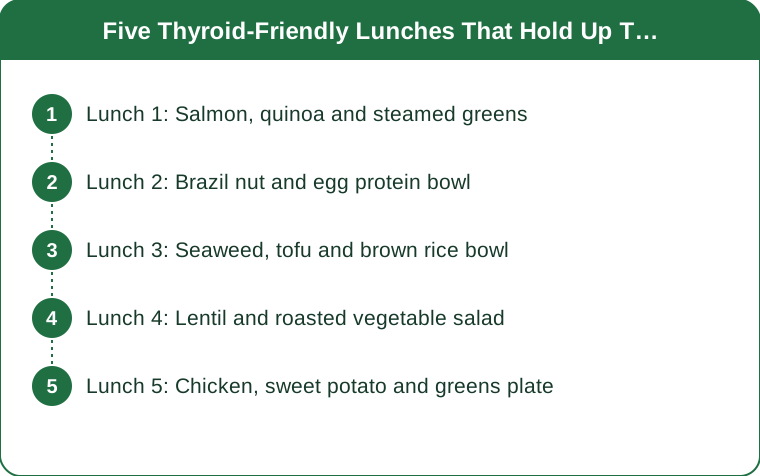
Lunch 1: Salmon, quinoa and steamed greens
The most nutritionally direct option on this list, and the one worth building a week around.
What it looks like: a fillet of salmon, roughly a cupful of cooked quinoa, and a generous handful of steamed or wilted greens, dressed with olive oil and lemon. Made the night before, eaten cold or gently reheated.
Why it works. Salmon delivers a substantial dose of protein alongside selenium, which is directly involved in the conversion of T4 to the active T3 hormone. It also provides omega-3 fatty acids and vitamin D, both of which are commonly low in people with thyroid conditions.
Quinoa provides a complete protein and a fibre-rich carbohydrate, which is what produces steady rather than spiking blood glucose. That steadiness is the difference between an afternoon that runs level and one that collapses at three o’clock.
The greens contribute magnesium, folate and fibre. On the cruciferous question — kale, broccoli, cabbage — the goitrogen concern is substantially overstated for people with adequate iodine intake, and cooking reduces the compounds considerably. Ordinary portions of cooked cruciferous vegetables are fine for the great majority of people.
Prep note: cook a batch of quinoa at the start of the week. The single biggest barrier to eating like this is assembly time on a weekday, and pre-cooked grains remove most of it.
Lunch 2: Brazil nut and egg protein bowl
The one to make when there is nothing prepared and you have ten minutes.
What it looks like: two or three hard-boiled eggs, a large handful of mixed leaves, cherry tomatoes, half an avocado, two or three Brazil nuts, and a slice of wholegrain bread on the side.
Why it works. Eggs are among the most practical complete protein sources available, and the yolk contains iodine, selenium and vitamin D — three of the four nutrients most relevant here, in one ingredient that keeps in the fridge for a week.
Brazil nuts are the notable item. They are exceptionally high in selenium, to the point that two or three provide a full day’s requirement. That is also the reason to be precise: selenium has a relatively narrow window between sufficiency and excess, and a large handful daily is genuinely too much. Two or three, not a bowlful.
Avocado adds fat and fibre, which slows gastric emptying and extends satiety, and the wholegrain bread provides a carbohydrate that releases gradually.
The assembly time is about eight minutes if the eggs are already boiled, which is the argument for boiling six on a Sunday.

Lunch 3: Seaweed, tofu and brown rice bowl
The iodine-forward option, and a genuinely satisfying one.
What it looks like: brown rice, firm tofu pan-fried or baked, a small amount of seaweed — nori strips or a spoonful of rehydrated wakame — edamame, cucumber, and a sesame dressing.
Why it works. Seaweed is the most concentrated dietary source of iodine there is, which the thyroid requires to produce hormone at all. The caution is that it is very concentrated indeed, and some varieties, kombu in particular, can deliver many times the daily requirement in a single serving. Nori, as used in sushi, is the mildest and the most sensible for regular use. A small amount a few times a week is the useful pattern; large daily quantities are not.
Tofu provides plant protein and is the other item requiring a timing note: soy can interfere with the absorption of levothyroxine, so it should be separated from the medication by several hours. Given that levothyroxine is normally taken first thing on an empty stomach, a lunchtime tofu bowl is generally comfortably clear of it — but it is worth being deliberate rather than assuming.
Brown rice and edamame add fibre and further protein, and the combination is unusually filling for its calorie content.
Prep note: pressing and baking a block of tofu on a Sunday gives you four lunches.
Lunch 4: Lentil and roasted vegetable salad
The batch-cook option, and the best of these for a week of busy days.
What it looks like: cooked green or Puy lentils, roasted vegetables — peppers, courgette, red onion, sweet potato — feta or a hard-boiled egg for additional protein, herbs, and a mustard vinaigrette.
Why it works. Lentils provide protein, a large amount of fibre, iron and zinc. Zinc is directly involved in thyroid hormone production and conversion, and it is one of the more commonly under-consumed minerals in plant-forward diets.
The iron note matters here. Iron absorption from plant sources is improved considerably by vitamin C, which the peppers and the vinaigrette provide, and inhibited by tea and coffee — so this is a lunch to keep away from a cup of tea by an hour if iron status is a concern for you. Iron supplements specifically must be separated from levothyroxine by at least four hours, as they bind it and reduce absorption substantially.
Roasted vegetables provide volume and fibre for very few calories, which is what makes this lunch satisfying rather than merely adequate.
Prep note: roast a large tray of vegetables and cook a pan of lentils on Sunday, and this lunch takes ninety seconds to assemble on four separate days.
Lunch 5: Chicken, sweet potato and greens plate
The straightforward one, and the easiest to build from leftovers.
What it looks like: roast or poached chicken, half a baked sweet potato, a large portion of green vegetables, and a spoonful of yoghurt-based dressing.
Why it works. Chicken provides a large amount of complete protein with minimal preparation, and protein is the macronutrient with the most direct effect on afternoon satiety. If the 3pm crash is your main complaint, protein at lunch is the first thing to increase, ahead of any other change.
Sweet potato is a fibre-rich carbohydrate with a gentler glucose response than white potato or white rice, and it provides vitamin A alongside it.
The yoghurt dressing adds a small amount of calcium — with the timing caveat that calcium, like iron, binds levothyroxine and needs to be several hours clear of the morning dose. At lunchtime this is rarely an issue.
Why greens in volume matter: the single most common failure in a thyroid-focused lunch is that it is nutritionally sound and too small, which produces a mid-afternoon snack that undoes it. Fill half the plate with vegetables and the calorie cost is minimal while the satiety benefit is large.
Prep note: this is the leftover lunch. Roast a chicken and bake several sweet potatoes at the same time on a Sunday evening and three lunches assemble themselves.
A note on medication timing, which applies to all five
Levothyroxine is absorbed best on an empty stomach, typically 30-60 minutes before breakfast or at bedtime well clear of food. Calcium supplements, iron supplements, and antacids should be separated by at least four hours. Coffee also reduces absorption and should be kept 30-60 minutes clear. None of these lunches conflict with a morning dose, and it is worth checking your own supplement timing against this.
This is general information and not medical advice. Thyroid conditions vary considerably, iodine and selenium both have upper limits worth respecting, and dietary changes should be discussed with the clinician managing your treatment — particularly if you are on medication, as significant changes in soy, iodine or fibre intake can affect dose requirements.
TL;DR:
- Build lunch around adequate protein, a fibre-rich carbohydrate, and a large volume of vegetables — the 3pm crash is usually a protein and glucose problem.
- Selenium (salmon, 2-3 Brazil nuts), iodine (nori in moderation, eggs, dairy) and zinc (lentils, meat) are the nutrients worth rotating through the week.
- Respect the upper limits: Brazil nuts a few at a time, seaweed in small amounts, and kombu rarely.
- Keep calcium, iron and soy several hours clear of levothyroxine, and coffee 30-60 minutes clear.
- Batch cooking grains, lentils, roasted vegetables and boiled eggs on Sunday is what makes any of this actually happen on a Wednesday.
The thing that determines whether a plan like this works is almost never the nutritional detail — it is whether the components are already in the fridge at midday on a busy Tuesday. Pick two of these five, prep for them once a week, and let the rest be ordinary.
Keep Reading
This article is for general informational purposes only and is not medical advice. Always consult a qualified health professional for guidance specific to you.