Why Your Thyroid Labs Can Come Back 'Normal' While You Still Feel Off
Quick Answer: Standard TSH-only testing can miss a meaningful subset of thyroid dysfunction because TSH is an indirect marker (a pituitary signal responding to thyroid hormone levels, not a direct measure of usable thyroid hormone at the cellular level) and because ‘normal’ reference ranges are population-based, not personalized. Asking for a fuller panel — free T3, free T4, and thyroid antibodies — provides a more complete picture when symptoms persist despite normal TSH.
A single normal TSH number gets treated as a definitive all-clear far more often than the actual physiology supports, and that gap leaves real people with real symptoms feeling dismissed or confused.

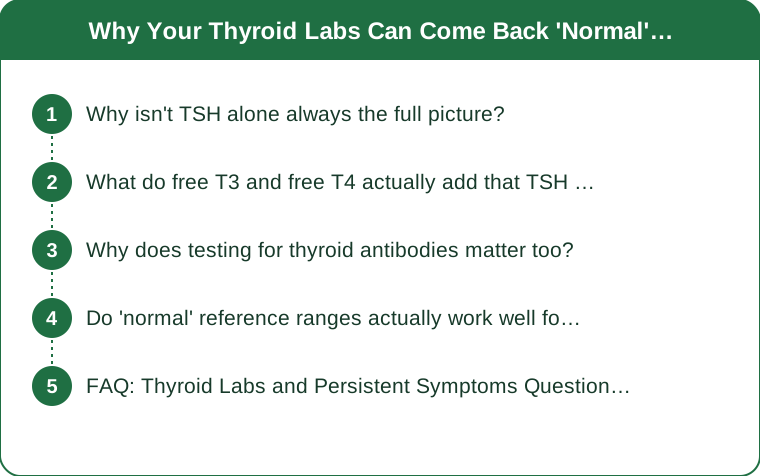
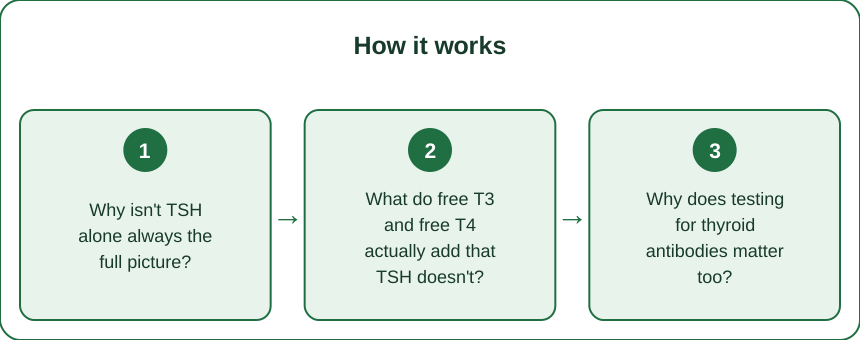
Why isn’t TSH alone always the full picture?
TSH is a pituitary hormone that responds to circulating thyroid hormone levels — it’s an indirect proxy for thyroid function, not a direct measurement of how much usable thyroid hormone is actually reaching and being utilized by your body’s cells. In most people, TSH correlates reasonably well with actual thyroid hormone status, which is why it’s used as the standard first-line screening test.
But some people have normal TSH with genuinely low free T3 or free T4, or have adequate hormone levels that aren’t being converted or utilized efficiently at the cellular level — situations where TSH alone looks ‘normal’ while actual symptomatic thyroid dysfunction is present.
What do free T3 and free T4 actually add that TSH doesn’t?
Free T4 measures the main hormone the thyroid produces directly, and free T3 measures the more biologically active hormone your body converts T4 into — testing these directly, rather than inferring status purely from TSH, can reveal conversion or utilization issues that a TSH-only test misses entirely.
Some people have adequate T4 but a conversion inefficiency that results in genuinely low usable T3, producing real hypothyroid-like symptoms despite a TSH reading that looks unremarkable on a standard panel — this is a specific, real clinical pattern, not a fringe theory.

Why does testing for thyroid antibodies matter too?
Thyroid antibody testing (particularly TPO antibodies) can detect autoimmune thyroid conditions, like Hashimoto’s thyroiditis, in an earlier stage before hormone levels themselves shift enough to show up as abnormal on TSH or even free T4/T3. Elevated antibodies with otherwise ‘normal’ hormone levels can still correlate with real symptoms and predict future thyroid dysfunction.
This test is commonly left out of a standard basic panel but is a reasonable ask when other markers look normal yet hypothyroid-pattern symptoms (fatigue, cold intolerance, hair changes) persist without another clear explanation.
Do ‘normal’ reference ranges actually work well for every individual?
Not perfectly — standard reference ranges are built from population averages, which means an individual’s own optimal, symptom-free level can sit at the edge of or even outside that broad range without technically being flagged as abnormal. Someone whose personal healthy baseline runs toward one end of the standard range might feel functionally hypothyroid at a TSH level still technically inside ‘normal,’ even though it’s abnormal for them specifically.
This is part of why tracking your own labs over time (rather than a single snapshot compared only to the general reference range) can be a more useful diagnostic tool when something feels off despite a technically normal result.
FAQ: Thyroid Labs and Persistent Symptoms Questions, Answered
Should I ask my doctor for a full thyroid panel if my TSH came back normal?
It’s a reasonable request if hypothyroid-pattern symptoms persist without another explanation — free T3, free T4, and thyroid antibodies together give a fuller picture than TSH alone, and most doctors can order this if you ask directly.
Can thyroid symptoms be caused by something else entirely if labs really are normal across a full panel?
Yes — persistent fatigue, cold intolerance, and similar symptoms have many possible causes beyond thyroid function, so a genuinely normal full panel is a meaningful data point that should prompt looking at other potential causes, not just more thyroid retesting.
How often should thyroid labs be rechecked if symptoms persist?
There’s no universal fixed interval — it depends on the specific clinical picture and what your doctor is monitoring for, but persistent unexplained symptoms generally warrant a follow-up conversation rather than assuming one normal test closes the question permanently.
TL;DR:
- TSH is an indirect proxy for thyroid function, not a direct measure of cellular hormone use
- Free T3 and free T4 can reveal conversion or utilization issues TSH alone misses
- Thyroid antibody testing can catch autoimmune involvement before hormone levels shift
- Population-based ‘normal’ ranges don’t always match an individual’s own healthy baseline
A single normal TSH result is informative but not necessarily the final word — a fuller panel is a reasonable next step when real symptoms persist despite it.
Keep Reading
This article is for general informational purposes only and is not medical advice. Always consult a qualified health professional for guidance specific to you.