Why Taking Thyroid Medication Near Coffee Can Undo Its Effect
Quick Answer: Levothyroxine needs an empty stomach to absorb properly. Coffee, food, calcium and iron all reduce how much of the dose reaches your bloodstream — coffee taken close to the dose can cut absorption substantially. The practical rule: take it with plain water, then wait 30–60 minutes before eating or drinking coffee, and separate calcium or iron supplements by about 4 hours. If your medication seems to have stopped working, check timing before assuming you need a higher dose. (General information, not medical advice.)
You take the pill first thing, exactly as instructed. Then you start the coffee, because that is what “first thing in the morning” has meant your entire adult life.
Those two habits are three minutes apart, and one of them is quietly eating the other.

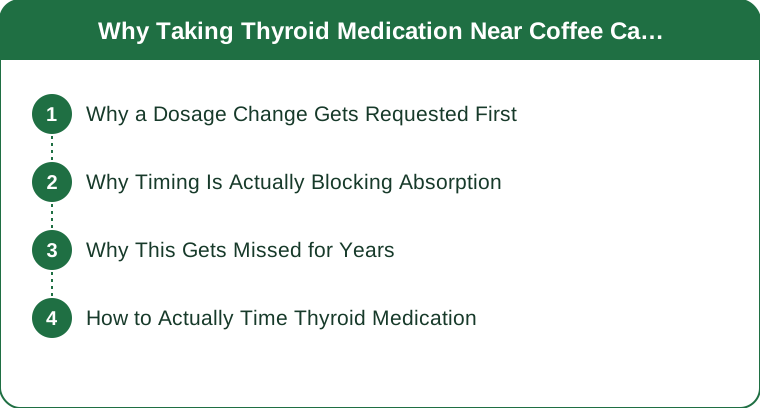
Why is my thyroid medication not working?
The instinctive answer is always the same: the dose must be too low. Symptoms persist despite taking the medication exactly as prescribed, so you book bloodwork and ask about an increase.
That’s a reasonable first guess — and for plenty of people it’s correct. But it skips a question worth asking first: is the full dose actually getting absorbed? A correctly measured tablet that only partially absorbs produces exactly the same picture as a dose that’s too small: lingering fatigue, cold intolerance, brain fog, and labs that don’t match the effort.
The difference matters enormously, because one of these is fixed with a prescription change and the other is fixed by moving your coffee.
How does coffee affect thyroid medication absorption?
Levothyroxine is absorbed in the upper small intestine, and it’s unusually sensitive to what else is in there.
Coffee is the best-documented everyday culprit — taken with or shortly after the dose, it can meaningfully reduce absorption. It isn’t the caffeine specifically; it’s the interaction with the tablet as it dissolves and moves through.
Food in general slows and reduces absorption, which is why the empty-stomach instruction exists at all. Breakfast 15 minutes after your pill is not a neutral event.
Calcium and iron are stronger blockers still — including calcium-fortified juice, antacids, and the multivitamin most people take without thinking of it as a drug. These need a much wider gap.
High-fiber meals and soy can also blunt absorption when taken too close.
The net effect: a full, correctly prescribed dose can deliver only a fraction of its intended benefit if the timing conflicts. Nothing about the tablet failed. It just never got in.

Why does this get missed for years?
Because taking it first thing in the morning genuinely feels like following the instruction. People remember “empty stomach” and interpret it as “before breakfast” — which is true but incomplete, since the gap is the active ingredient of the advice, not the ordering.
Three other things keep it hidden:
- The habit is invisible in a consultation. “Do you take it on an empty stomach?” gets an honest yes. Nobody asks when the coffee happens.
- Partial absorption looks like an underdose in labs, so the fix that gets tried is a dose increase — which sometimes works, at a higher dose than you actually needed.
- It can be inconsistent. Coffee at 10 minutes on weekdays, 45 minutes on weekends, means variable absorption and lab results that never quite settle.
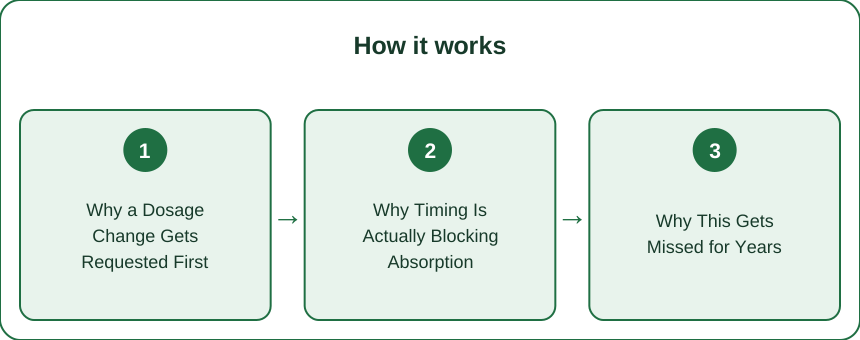
How should you actually time thyroid medication?
The routine that protects the dose:
- Take it with a full glass of plain water, on a genuinely empty stomach.
- Wait 30–60 minutes before coffee or food. Sixty is the safer target if your mornings allow it.
- Separate calcium, iron and multivitamins by about 4 hours — this includes fortified juices and antacids.
- Be consistent. Same routine, same gap, every day. Consistency is what makes your next blood test actually interpretable.
- If mornings can’t accommodate the gap, a bedtime dose — at least 3–4 hours after your last food — works well for many people. Change to it only with your prescriber, and retest afterward.
- Retest about 6–8 weeks after changing anything, whether that’s the dose or the timing.
A practical trick: keep the tablet and a glass of water on your nightstand and take it when you first wake, before you’re even upright. The gap then runs while you shower and get dressed, and the coffee is no longer competing with anything.
Myth vs Fact
Myth: A few minutes of gap is close enough. Fact: Minutes are not the unit here — the window is 30–60 minutes precisely because dissolution and absorption take that long. Three minutes and thirty minutes are very different outcomes.
Myth: Decaf is fine. Fact: The interaction isn’t purely about caffeine, so decaf coffee is not a reliable workaround. Water is the only safe companion in the gap.
Myth: If timing were this important, my doctor would have made a bigger deal of it. Fact: It’s on the label and in the guidance, but it’s easy to under-explain in a short appointment — and patients reasonably hear “before breakfast” rather than “protect a 30–60 minute window.”
Myth: Once absorption is fixed, you can stop being careful. Fact: Your dose is now calibrated to that routine. Changing the routine changes the effective dose, which is why consistency matters more than perfection.
Mini FAQ
How long after levothyroxine can I eat or drink coffee?
Aim for at least 30 minutes, and 60 minutes if you can manage it. Plain water in that window is fine and actually helps. If you routinely can’t wait, discuss a bedtime dose with your prescriber rather than quietly closing the gap.
Can I take my thyroid medication with my other supplements?
Not calcium, iron or multivitamins containing them — separate those by roughly 4 hours. Most other medications are less of an issue, but check with your pharmacist, who can review your whole list in a couple of minutes.
When should I see a professional?
Talk to your doctor if symptoms persist despite consistent timing, if they return after a stable stretch, if you’re pregnant or planning to be, or if you develop palpitations, tremor or unusual anxiety — all reasons for a prompt review. Never adjust your own dose to compensate for timing; fix the timing and retest instead.
TL;DR:
- Levothyroxine needs a genuinely empty stomach to absorb fully.
- Coffee, food, calcium and iron all reduce absorption.
- Take with plain water, then wait 30–60 minutes before anything else.
- Separate calcium/iron/multivitamins by about 4 hours.
- Consistency beats perfection — same routine daily.
- Suspect timing before asking for a dose increase; retest in 6–8 weeks after any change.
Protect the window, and the dose you were already prescribed starts doing its job.
Keep Reading
This article is for general informational purposes only and is not medical advice. Always consult a qualified health professional for guidance specific to you.