Why Late-Summer Fatigue and Thyroid Fatigue Get Mistaken for Each Other
Quick Answer: End-of-summer slump — cumulative heat load, hot-night sleep debt, schedule chaos, and the light beginning to shift — produces tiredness, brain fog, low mood, and sluggish workouts. Hypothyroid fatigue produces the same four, which is why every August a wave of people wonders which one they have. The separators are pattern and company: slump fatigue fluctuates with conditions and lifts with a good week; thyroid fatigue persists regardless, and travels with companions like cold intolerance, hair and skin changes, constipation, cycle changes, and unexplained weight drift. A two-week log usually points one direction — and a simple blood test settles it.
Here is why the two feel identical from inside, what separates them, and what to do while you find out.

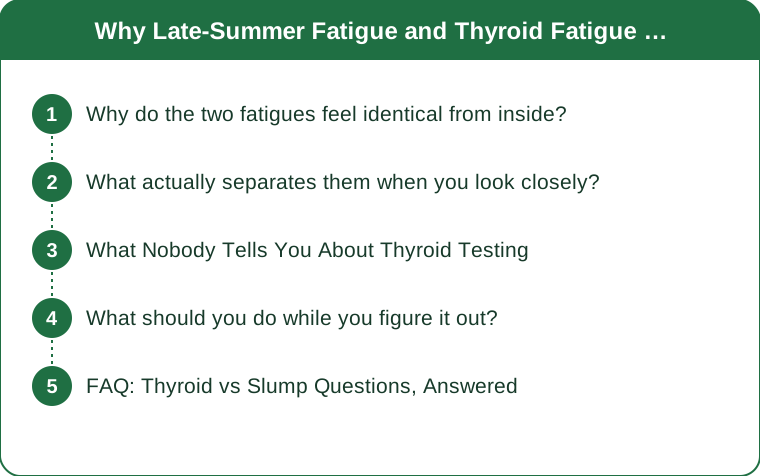
Why do the two fatigues feel identical from inside?
Because they converge on the same output: a body running below its usual rate.
The overlap list is long and honest. Tiredness that sleep does not fully fix, mental fog and slow word-finding, flat mood, workouts that feel heavier at the same loads, more napping, less initiative. Both conditions produce every item — fatigue is a final common pathway, and dozens of causes drain into it.
Late August earns its slump physiologically. Weeks of cumulative heat exposure tax the body even in air conditioning; hot bedrooms shave sleep quality nightly until the debt is structural; hydration runs chronically a little behind; routines — meals, training, bedtime — drift through vacation season; and the first shortening of evenings begins nudging mood and energy in sensitive people. Stack those for six weeks and you produce genuine, measurable exhaustion with no disease anywhere in it.
Hypothyroidism arrives at the same station by a different track. Thyroid hormone sets metabolic pace body-wide; when levels run low, everything slows — energy production, temperature generation, digestion, cognition, even hair and skin turnover. The fatigue is the felt surface of a system-wide slowdown.
And the timing overlap is cruel: thyroid symptoms build gradually over months, which means a problem that began in spring often becomes undeniable in exactly the season with a ready-made alternative explanation. That is how six-month diagnostic delays happen — every month has its excuse, and August’s is the best of all.
What actually separates them when you look closely?
Pattern, company, and response — three lenses, one log.
Lens one: the pattern over two weeks. Slump fatigue fluctuates — better after the cool weekend, worse after the brutal week, responsive to one genuinely good stretch of sleep. Thyroid fatigue is a flat line that does not negotiate: the good week arrives and the tiredness stays. Fatigue that improves with rest and conditions points to load; fatigue indifferent to both points to physiology.
Lens two: the companions. The slump travels light. Hypothyroidism brings luggage: feeling cold when others are comfortable — genuinely strange in a hot August, and therefore the single most useful tell of the season; skin drying and hair shedding or thinning; constipation; menstrual cycles growing heavier or irregular; weight drifting up without habit changes; puffiness around the face; a slower resting heart rate. None alone is diagnostic; two or three alongside persistent fatigue change the question.
Lens three: the response to fixes. Give the slump its remedies — cooler sleep, rehydration, one honest recovery week, routine restored — and it visibly yields within days to two weeks. Thyroid fatigue shrugs at all of it, which is itself information.
The two-week log makes the lenses practical: each evening, one line — energy 1 to 10, sleep hours and quality, heat exposure, training, plus any companion symptoms. Fourteen lines take four minutes total and convert I am always tired into a pattern a clinician can actually use — or into visible proof that the cool week fixed you and the question is closed.

What Nobody Tells You About Thyroid Testing
The entry test is simple and cheap. TSH — often paired with free T4 — is a standard blood draw, widely available, and the correct first step; it is how the question gets answered rather than ruminated on. If the screen is abnormal, follow-ups exist; if normal, you have bought real peace of mind for the price of a needle.
Biotin can fake your results. High-dose biotin — ubiquitous in hair, skin, and nails supplements — interferes with common thyroid assays and can make results look falsely abnormal or falsely fine. Standard practice is pausing biotin for at least a couple of days before the draw; mention every supplement you take, because this one genuinely changes numbers.
Timing and repetition matter more than people expect. TSH runs a daily rhythm and drifts with season, illness, and stress; borderline results are commonly re-tested weeks later rather than treated on one number. A single mildly odd value is a flag for follow-up, not a diagnosis.
Family history moves the odds. Thyroid conditions cluster in families and land disproportionately on women, with risk rising after pregnancies and across midlife. A mother or sister with a thyroid story is a legitimate reason to test sooner rather than later.
Normal ranges are genuinely debated at the margins — which is a reason for professional interpretation, not internet adjudication. A clinician reads your number against your symptoms, history, and prior values; a forum reads it against anecdotes.
And do not start supplements as a substitute for the test. Iodine and kelp products in particular can worsen some thyroid conditions; the test-first order is not bureaucracy, it is safety.
What should you do while you figure it out?
Run the fixes that help both — and book the test if the flags are flying.
Treat the slump seriously either way. Cool the bedroom properly for the last hot weeks; rebuild the hydration floor; restore meal and sleep timing after vacation drift; and take one deliberately easy training week rather than punishing tired sessions — if it is the slump, this package is the cure, and if it is thyroid, it removes the noise so the pattern shows clean.
Feed the system without megadosing it. A normal diet covering iodine (dairy, seafood, iodised salt), selenium (fish, eggs, a Brazil nut’s worth), and iron supports thyroid function adequately for most people. Skip kelp and high-dose iodine supplements entirely — more is not support, and excess iodine can aggravate the very conditions being questioned.
Keep moving, gently. Walking, easy strength work, and unhurried swims maintain energy pathways and mood without adding recovery debt. If real hypothyroid fatigue is present, brutal cardio does not push through it — it deepens the hole. Train at conversation pace until the question is answered.
Book the appointment on any of these: the flat-line pattern after two honest recovery weeks; fatigue plus two or more companions — especially cold intolerance in summer; a strong family history; or symptoms after pregnancy, where thyroid dips are common and commonly missed. Bring the fourteen-line log; it shortens the conversation and sharpens the testing.
And a reassurance worth stating: both answers are good news. The slump resolves with the season’s turn and a fortnight of care; thyroid conditions, once named, are among the most treatable chronic conditions in medicine, with most people returning to full energy on straightforward treatment. The only bad outcome is the unanswered question dragging into December.
This is general information, not medical advice — persistent fatigue deserves a clinician’s eyes and an actual blood test, not another month of guessing.
FAQ: Thyroid vs Slump Questions, Answered
What is the single strongest clue it might be thyroid?
Persistence plus company. Fatigue that ignores a genuinely restorative week, travelling with cold intolerance, hair or skin changes, constipation, or cycle changes, has outgrown the weather explanation. In August specifically, feeling cold while everyone else is warm is the standout tell.
Can heat itself cause weeks of exhaustion without anything being wrong?
Yes — cumulative heat strain plus night after night of degraded hot-weather sleep produces real, deep fatigue in perfectly healthy people, and it lifts within a week or two of cooler nights and deliberate recovery. That responsiveness is exactly what distinguishes it.
Should I just get the blood test now and skip the two-week log?
If companions or family history are present, book now — the log can run while you wait for the draw. If it is fatigue alone in a heat wave after a chaotic month, two weeks of pattern-plus-fixes often answers the question free and makes any eventual appointment far more productive.
Does subclinical hypothyroidism explain mild tiredness?
Sometimes, and it is precisely the territory where professional interpretation matters — mildly elevated TSH with normal T4 may be monitored or treated depending on symptoms, age, and trajectory. It is a conversation with a clinician holding your numbers, not a self-diagnosis from a screenshot.
TL;DR:
- August slump and hypothyroid fatigue share the same surface — tiredness, fog, flat mood, heavy workouts — which is why every late summer breeds the question.
- The separators: slump fluctuates and yields to a good week; thyroid persists and travels with companions — summer cold intolerance, hair, skin, gut, and cycle changes.
- Keep a fourteen-line evening log, run the recovery package that helps both, feed iodine and selenium from food, and skip kelp megadoses entirely.
- Flat-line fatigue, two-plus companions, family history, or postpartum timing means book the simple blood test — and pause biotin before the draw.
Start the four-minute log tonight. In two weeks you will either have your energy back or the exact evidence your doctor needs — both beat another month of wondering.
Keep Reading
This article is for general informational purposes only and is not medical advice. Always consult a qualified health professional for guidance specific to you.